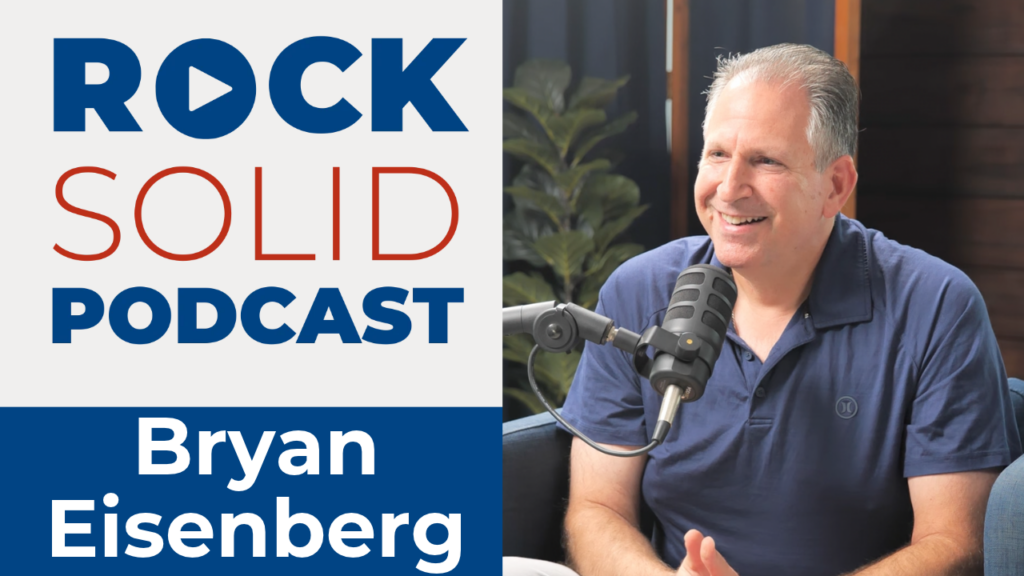
Bryan Eisenberg refused to cut most of the ribbons, and the Round Rock Chamber ambassador group he leads grew from about 20 people to nearly 50. For episode 100 of Rock Solid, Bill Combes turned the interview around and made the host answer the questions for a change.
Bryan is the author of 12 books and a co-founder of BuyerLegends. He joined the chamber only because a franchise told him to hold a ribbon cutting, and that ribbon cutting happened on October 11, 2023. COVID had shut down much of his keynote speaking, and a lot of his friendships went with it. The chamber filled that room back up.
When Bill asked about AI, Bryan answered with a story about office admins. After World War II, companies hired more and more of them, and the person who managed all those admins had one job: check the work. That job is coming back, he says, this time for AI agents. His warning is short. They will do crazy things.
That is a Round Rock story as much as a tech story. Bryan’s ambassadors visited well over 100 local businesses this year, members and non-members, and now want to do it twice a year. The visits grew out of a downtown crawl that kept hitting the same few businesses. The fix was to split the group up and send everyone everywhere. Nobody planned that crawl around one person holding the scissors.
There is more in the last ten minutes. Bill runs Bryan through ten rapid-fire questions, including a story about why he would never be a mortician. So here is the question to carry in: what are you still holding onto that someone near you is ready to own?
Key Takeaways From This Episode
- Give away the visible work. Bryan turned down most ribbon cuttings so other ambassadors could present, and says he has watched people blossom. Hand people the stage and the group grows.
- Own the check, not just the task. His rule for AI is trust but verify. Your job is to question, think, and validate, because he figures it may take 20 years before we can completely trust AI.
- Average is the default. Bryan says models are trained on the average of everything, and average is not that good. The advantage goes to whoever owns the best data.
- Use AI to buy time back. Even an hour a week counts. Bryan asks what you would do with it, and connects it to the day his son asked to play catch.
- Round Rock runs on handing people the scissors. Ambassadors visited well over 100 local businesses this year, and a buddy program and a new ambassador orientation came from members, not the vice chair.
No, this is an opportunity for everybody to present and get comfortable in front of groups. And I’ve seen people blossom because of that.
Bryan Eisenberg, Co-founder, BuyerLegends
Trust but verify. Your job is not to let it do the job for you, but to start questioning and thinking and validating.
Bryan Eisenberg, Co-founder, BuyerLegends
I’ve invested 30 plus years of my life to becoming an entrepreneur. So I have that freedom. So I was able to be there for all those games.
Bryan Eisenberg, Co-founder, BuyerLegends
Episode Chapters
- [00:00] Episode 100 Flips the Script, Bill Combes takes the interviewer’s chair and Bryan takes the guest seat.
- [01:25] What 99 Conversations Taught Him, Why Bryan thinks Williamson County is a model for every community.
- [04:34] The Ribbon Cutting That Started It, How a franchise requirement led Bryan into the Round Rock Chamber.
- [07:22] What 25-Year-Old Bryan Would Not Believe, A former priest turned boss kept asking when Bryan would write his book.
- [09:30] AI and the Next Generation, What AI means for the kids entering the workforce.
- [11:57] From Admins to Agents, The post-war office boom and what managing AI looks like next.
- [12:43] The Average Problem, Why training data decides who wins the AI race.
- [16:28] Leader of Leaders, What changed in the ambassador group and why Bryan stopped taking every ribbon cutting.
- [20:26] If Round Rock Were a Client, A century-old donut shop becomes a brand lesson.
- [22:27] Looking Ahead to Episode 200, Why the 99 conversations were the real prize.
- [24:02] Ten Questions, Actors Studio Style, Rapid fire, including a profession Bryan would never try.
- [25:09] Playing Catch and The Full Plate, The moment behind his books and the hour AI could give back.
- [29:37] How to Reach Bryan, Where to find him in person and online.
Frequently Asked Questions
How did Bryan Eisenberg get involved with the Round Rock Chamber?
A franchise his company bought into required a ribbon cutting. That ribbon cutting took place on October 11, 2023, and the chamber events that followed, including Million Cups, pulled him in.
How many ambassadors does the Round Rock Chamber have?
Bryan says the group hovers between 48 and 50 ambassadors, up from about 20 when it started. He credits that growth in part to giving more people the chance to lead ceremonies and programs.
What does Bryan Eisenberg say about managing AI?
His rule is trust but verify. He compares it to managing office admins in the 1960s and 70s: the manager’s job was to check the work, and the next generation of managers will do the same for AI agents.
Why does Bryan say AI output can be average?
He says the models were trained on the average of everything, and average is not that good. In his view, the companies with the best training data will benefit most from each advance.
What is The Full Plate?
It is Bryan’s 12th book, and he says he just finished the draft. He wrote it for people who feel overwhelmed by everything in their lives, and says AI used well can buy back time, even an hour a week.
About Bryan Eisenberg
Bryan Eisenberg is the host of Rock Solid, a New York Times bestselling author, and a co-founder of BuyerLegends. He is also co-owner of A Place At Home North Austin with his wife, and vice chair of the Round Rock Chamber ambassadors. He is currently finishing his 12th book, The Full Plate.
Connect: BryanEisenberg.com
More From Rock Solid
If this episode resonated, hear Kristin Stevens on Answering Growth With Welcome and Ali Khataw on the Pay Cut That Grew His Firm. Both guests show what leading by giving something away looks like. Browse more Round Rock Chamber stories and leadership episodes.
Watch or Listen
Full Episode Transcript
Click to read the full transcript
Transcript lightly edited from auto-generated captions. Speaker labels are not included. Bill Combes asks the questions and Bryan Eisenberg answers; Brent Pierce opens the episode.
Welcome to Rock Solid, the Round Rock Business Leaders Podcast. Today we are celebrating episode 100. My name is Brent Pierce. I’m the producer and the behind-the-scenes guy here for this podcast. Two years ago, when Bill Combes, Bryan Eisenberg, and myself had this idea to start a podcast, we never dreamt that we would get to episode 100. So, this is kind of a big deal for us. Today, we’re flipping the script a little bit. Typically, Bryan Eisenberg interviews guests. Today though, Bill is going to interview Bryan. So, this will be a lot of fun. If you’ve been with us since the beginning, throughout this journey, thank you so much. Welcome back. If you’re new, welcome. We release weekly episodes talking to people from the community about business, about life, about entrepreneurship, fellowship, community, philanthropy, and so much more. There’s a like button on your screen somewhere. There’s a subscribe button that will ensure that you get all of our future episodes.
It’s been a lot of fun producing these episodes and we get to meet some incredible people that come through the door here at the studio. So, without further ado, let’s dive in. Welcome to the Rock Solid Round Rock podcast. We’re switching things up a little bit. I’m very, very excited today to be interviewing our host, Bryan Eisenberg. So, there’s something pretty cool about this because you interviewed me on episode one. And now 99 episodes later, we’re switching things up. I’m really excited to be spending some time with you today. Let’s start out with, after nearly a hundred conversations, you’ve interviewed so many different individuals in the community. What are some of the few things you learned about the community and the people in it and the impact that they’re making? It’s funny you say that because when we first started at Episode One, our goal was to bring the people we meet in the community out to the people who don’t get out as often. And I guess at some point I started relooking at the podcast not as that story, but as this story of Williamson County, I think it was after Judge Grall’s [spelling unclear] episode, where he talked about how Williamson County was one of the fastest growing counties in this country. And I started piecing together, well, we keep hearing so many of the same things conversation after conversation: how the city works with the chamber, with the businesses and the nonprofits, and everyone seems to work together, and we come together as neighbors. We’ve had such a diverse universe of guests here as well that I started realizing this community is a great model for what we should be doing in every community across the states. That we’d all be that much more prosperous. We’d be growing like Williamson County if we followed this model. And that became my passion to tell more of this story, because the people here are what is amazing. No matter if we sit on opposite sides of the political spectrum, religious spectrum, football preferences, it doesn’t matter. If your car breaks down, I’m there. If your house gets hit by a tornado or a hurricane, which we know it never will because Bill wrote the book on how to prevent them, but yeah, that’s really what I’ve taken out of all of these conversations.
That’s great. I agree with you. It’s been really amazing to listen to the stories of people and even learn a lot about people that I’ve known for a while, and now all of a sudden some of these stories are coming to light and it just strengthens that belief in this community and what we’re doing in the community and what the future holds for our kids, because that’s also important. And we’ve had a number of kids on the podcast as well who’ve just shown us the future is bright, there’s so much opportunity. I’m working with the school district now on a couple of different projects, at Stony Point and at Round Rock High School. And it is really cool to see that the kids are encouraged, and it is part of this community that allows them to be in that position and to feel good about themselves in the future. So that’s exciting. Well, we were both born in New York. To me it’s amazing. I like to study how people get connected and I have a well-diverse history of connecting with people. You’re one of my closest connections. In the last 5 years I think we’ve developed an amazing relationship. I consider you probably one of my best friends. What would it look like today if you did not start A Place At Home and get involved with the chamber and have that ribbon cutting on October 11th, 2023, where we really first got to connect in person and I got to meet your family? I joined the chamber because we bought into a franchise and the franchise told us, you need to have a ribbon cutting. I was like, “Okay, just one more thing.” And got a budget for that. We were self-funding the company, so I said, “Okay, I’ll do what we have to do.” In 30-plus years of being in business, I’ve never really interacted much with chambers. I’ve been involved with a lot of associations. I’ve started my own association. So I understand the value of them and I was like, “Okay, let me go do that.” The ribbon cutting was one of the first things, but it was more all the events that the chamber put on, afterwards connecting at Million Cups. The timing couldn’t have been better. I’d been going through a lot of things in the previous years. COVID shut down a lot of the keynote speaking that I was doing. A lot of my close friends were friends from all over the globe on the speaking circuit with me, and those kind of disappeared. I didn’t realize how isolated I felt from that. And then my brother had had several bouts of cancer that he was fighting, and he’s fine today, but that was also another isolation point.
Being able to connect, and like they say, entrepreneurship can be lonely. It was definitely feeling lonely and I was definitely having those symptoms. I’m so blessed by all the relationships, obviously including yours and Brent’s and so many others, that this chamber has brought me. I feel like it opened up maybe a new chapter in Bryan’s life to say, you know what, I may have been hitting a couple of brick walls, and this allowed you to find an entire new community of people. You’ve helped enhance that community, and that’s what I’m really excited about. I have a couple of questions about that later on, because the impact that we make sometimes is not necessarily recognized, but I recognize it. So I’m happy you’re involved in the chamber. I’m happy that you started A Place At Home to get you into the chamber, because who knows where you’d be if not. So it’s been good. Everything happens for a reason. Absolutely. I firmly believe that. What is something today in your life that the 25-year-old Bryan would have thought was absolutely ridiculous? Oh, there’s a lot there. The first one, and I’ve told the story a few times: when I was an early social worker, in my previous career before I even started thinking of becoming an entrepreneur, I had a boss who was a former priest who was an alcoholic and got kicked out of the church. He lived on the Bowery as a homeless guy for years. And he was my manager at one of the places where I was working. Fred has a lot of meanings for me. He’s been a mentor in my life multiple times. Plus it was my dad’s middle name too. But Fred kept telling me, “When are you going to write your book?”
And I would look at Fred like he was nuts. And he probably was in many ways. But back then, I barely read. I wasn’t a fan of reading, let alone writing. And to think that I’ve now just completed the 12th book of my life and have New York Times bestsellers that have helped me go across the whole globe, I could never have imagined. And then obviously tie that into my family and what they’ve accomplished and where they’re going, and the family that I’ve built: three amazing kids, my wife who’s amazing at everything she does and touches so many people. People think I’m involved. They have no idea until they hear the things that she’s doing on a daily basis. I would have never imagined that at 25. Yeah, I agree. So, speaking of ridiculous, and I’m not going to phrase this as ridiculous, but we’re at a point now where I think you and I are looking at things going, man, this is kind of ridiculous. I know your kids are very important to you, as are my kids to me. Now that they’re beginning to enter the workforce, how do you see AI and all this insanity affecting them, affecting younger generations, even affecting us? It’s obviously a big topic. Everyone’s talking about it and I’m just interested in your take on how you think it’s going to affect our kids. I mean, it’s going to have massive ramifications. We look at any of the revolutions: the industrial revolution, the car coming in instead of the horse and buggy, and then the internet. I was fortunate to be involved in the very early days of the internet, seeing that go on, and that took a long time because it’s a massive shift in communications that we never had previously. I was there. AI is just changing things at a ground-shifting level. It’s going to impact so many different areas of our lives. My daughter’s working in cyber security, and there are discussions about what she’s doing in her role and how AI plays into it and the things it can help her build. Again, just unbelievable.
Sammy, who’s now the baseball manager at Shields, they’re using AI for product knowledge and for creating presentations and for training purposes as part of what they’re doing. Again, this is baseball. You’d never think it’s such an important role, but it absolutely does play a role there. And then just this week, Matthew got accepted into UTSA. They have an online program, so he’ll still be at home, still working at Shields part time, but he’s going in for AI and cyber security. The key thing that I’ve told them is it’s a great tool, and like I tell everybody, trust but verify. Your job is not to let it do the job for you, but to start questioning and thinking and validating, and those are the skills that are going to carry you on no matter what, because it’s going to take 20 years until we can completely trust AI. It’s the same way I told the story when I was just speaking up in Waco: after World War II, and going to the 60s and 70s, we started seeing office work explode, we started seeing an increase in the number of admins coming into the world. And the job of the person who had all these admins was to manage all the admins and check their work and make sure it was adequate and all of that. That’s going to shift. We’re definitely going to lose that. That’s where we’re seeing the job loss, sort of. But the next roles are going to be how do you become managers of agents. And it’s the same thing: you have to verify, make sure they’re doing it the right way, that they grab the right data. They do crazy things, because they will do crazy things. They’re a lot like college [word unclear in captions]. They’ll get smarter, but you’re still going to have to focus in on that level.
Do you feel like the people inputting the data are going to have much more critical thinking to do in order to make sure that the models improve and don’t fall apart? Well, there are two aspects to this. Number one, realize it’s been trained on the average of stuff. And the average of stuff is just not that good. It’s average, just by the very nature. We’ve got the bell curve, right? If you took all the stuff at the top end of the bell curve, and we’re seeing people who develop models using that kind of stuff, it’s brilliant at what it does. When you started adding in all the rest of the stuff, that’s where it gets scary. Again, we’re just seeing rapid development in how far we can push it based on what it’s been trained on. But where that’s going to go, that’s going to change the whole game. So, to make a parallel here with the beginning of the internet, because I was there. I was at KU installing IP addresses on Sun Sparc computers. We had a bunch of browsers that came out: Excite, AltaVista, Ask Jeeves, all these different ones. And now we’re down to essentially Google at this point. We’ve got Gemini, we’ve got ChatGPT, we’ve got Claude, and we’ve got Perplexity. So let’s say there’s five right now. Do you see there always being five? Do you see it going to 20? No. You and I talk about this because I know you invest in these funds with AI, and yes, I still believe there’s a lot of growth there. But again, it comes back to what we just talked about. It’s the training data. Ultimately I think some of these have not been trained on great data. Are the advancements great? Yes. And all that’s going to do is help the guys who have the best training data with their advancements. So Google does not necessarily have the best product today. They’re dabbling. They’re doing some stuff, but I think they’re taking the position of what Apple has done in the past: I don’t need to be the leader anymore. When I find things that the leader does well, I’m going to just keep owning the data. And they own so much data. I shared a post this past week off of something I talked about in 2013: if I were Google and I was planning my algorithm for how things showed up, would I be using Bill’s specific purchases from emails to guide the algorithm? But could I use that data set to train an AI to understand what’s actually getting purchased and what should show up more often? I would certainly think so. Would I use browser data from Chrome and Android data and all the websites where they have analytics? At one point I knew it was over 65% of all websites had Google Analytics on them. And believe me, I believe Google actually kept all the data separate, but did they use it to train? I’m sure. And today obviously their big benefit is all that’s on YouTube, all these podcasts, everything that goes on, countless hours every day, and how people interact with it. And then of course all the local business stuff, which for us we’re very passionate about. All that Google Business Profile data is a whole different world that nobody else has access to. And the world is local. That’s a good answer.
One of the most exciting things for me about your involvement in the chamber is you being added to the board as vice chair for the ambassadors. And in true New York fashion, you’ve gone all in, right? That’s what we do as New Yorkers. When we have a task, we go all in. What are some of the changes and implementations that you have put in place as the head of the ambassador group over the last year that you’re most proud of? Do you feel like they have made the most impact? Chambers have been around 100-plus years, and my biggest concern, again, we’ve been talking so much about AI, is how much the world is changing. I was like, we can’t keep doing things the way we’ve done them for the last 20, 30, 40 years. We have to start thinking about what a chamber looks like, what ambassadors look like going into 2030. That was my first thing that I knew we needed to do. Obviously the impact for local business today is, do we have people who leave reviews? Do we have people who post on social media? Do we have people who comment on other people’s posts on social media recommending our local chambers? And we’ve got now almost 50 ambassadors. We teeter between 48 and 50. We keep going back and forth, but more people keep applying and wanting to become ambassadors. It’s a lot more than we started with. We started at around 20. So obviously that’s phenomenal. But my biggest thing, and the biggest compliment I get, and I get it from somebody who’s been involved in the ambassador group for many, many years, is that I’ve become a leader of leaders. The first thing was that I wasn’t going to be the one who did all the ribbon cuttings, all the ceremonies, because it always used to be the chair and the co-chair and then maybe one other backup. And I was like, “No, this is an opportunity for everybody to present and get comfortable in front of groups.” And I’ve seen people blossom because of that. That one was very important for me. And then how many people have stepped up into new leadership roles? We just launched a new buddy program that came from Victoria Brooks from A+ Credit Union. We’ve got John and Maria, who followed Don Cesler’s footsteps to start orientation for new ambassadors. That’s been a phenomenal program we’ve rolled out over the last couple of years. And I’ve got one more thing still planned. We just finished another one last week. For the last couple of years we did a little crawl where a few ambassadors would go around downtown and visit businesses. We’d break up into groups, but we’d end up hitting a lot of the same businesses, because there are only so many businesses downtown that you can walk through. This year we took our ambassadors and split them into groups. They went literally every corner of Round Rock. We visited well over 100 businesses, both board members’ businesses, member businesses and non-member businesses. We went out with a little bit of a survey as well, and just touched so many more people, to the point now that the group wants to do it more frequently. They want to do it at least twice a year. We’re very excited by that program, and the work that Iris Day did to help organize it. I’m mind-blown by everything she does.
That’s great. I’ve been vice chair for entrepreneurship for two years now, and I plan on staying on that group. We don’t know who will be taking over next year, but I think sustaining that over time is going to be important, because we don’t want to see a drop-off in all the work that we’ve done. So I think it’s going to be exciting and important to continue to be involved and to continue to push these groups to provide more to the community as a chamber member. So, let me put you on the spot for a second. If the city of Round Rock were one of your consulting clients and you had to define the brand in one sentence, what would that be, and what part of the story are we not telling enough of? Oh, that’s a great question. The things that pop to mind for me real quickly, and I’ll start with Round Rock Donuts. Round Rock Donuts has been a business here for a hundred years now. I actually did include them in my latest manuscript, The Rice and Beans Millionaire: The Full Plate. And there’s a reason why, and I’ve used their story a number of times. It started from the same little bakery, using the same recipe 100 years ago, when this town was tiny, tiny, tiny. But there’s so much value that has gotten built around it. And they stay consistent, cohesive, with a great recipe that’s unique and in fact legendary. We’ve talked about it, the 21st most legendary dessert in the world. I forgot the exact source for it, but it’s been named that. And I think that says a lot about what Round Rock is. You put together the right ingredients and you keep building value. You create long-term value because it all works together. And it stands out. And Round Rock, like Austin’s cool, but Round Rock’s got something uniquely special. Just like the Round Rock. We’ve been lucky, I think, over the years with the leadership that has been in place and continues to come up in the rankings to help lead the city. And we’ve had several of them here who’ve shared their stories about that. It’s just important.
So we’re sitting here at episode 100, and let’s imagine us doing this again at episode 200. What do you hope will be better, different, changed within the Rock Solid Round Rock podcast? And how will you feel about getting to episode 200? When we first started, 100 seemed like a lot. We knew the people and the leaders and the top names we wanted to go after. And what’s cool is now we’re getting guests that neither of us know from the community, who have amazing stories and amazing ties to the community. I like to tell people that the biggest value I’ve gotten out of this is the 99 conversations that I’ve had. In today’s world, we’re all so busy that we’re busy texting. We barely make phone calls. The time to research a guest and then meet with them and then write about them afterwards and share their story on social media, to me that’s priceless. I’ve gotten so many more connections to people, and deeper connections, because of that. So I’m excited about who the next hundred people who’ll be sitting in these seats are. It’s going to be fun. All right, we’ll start to wrap up. One of my favorite shows that no longer airs is a show that was on A&E for many years called Inside the Actors Studio. I don’t know if you’ve ever seen it. I’ve seen a few episodes. If you have seen it, they close things out with 10 questions. James Lipton would ask these questions to the actors being interviewed. So we’re going to go through those questions really quick and see how you would respond. Brent may need to use the beeper on one of these. What is your favorite word? That changes throughout my life, but I believe today I would probably say alignment. What is your least favorite word? Oh, there are so many. That’s why this is so fun. People using the word authentic when it’s completely not. It’s that sugary authenticity that just leaves me feeling icky. What turns you on creatively, spiritually or emotionally? This past week I finished the draft of this 12th book. The reason I wrote it is because I see these common issues every day with people in the chamber. It’s called The Full Plate because I see so many people struggling today, being overwhelmed with everything in their life. I watch you as a friend and I’m concerned. You’ve had your health issues, you’ve got your son with basketball, late nights, the work, all the chamber stuff. We take on a lot and it’s hard for some of us to say no. I just want people to know that there are better ways to do things, and it’s so important to become an entrepreneur for the right reason. I wrote the first version of The Rice and Beans Millionaire, and I’ll never forget the moment that inspired the book. It was because Sammy, my middle one, in the middle of the day, I was sending out an email and he asked me if we could go play catch. And I caught that first ball and I realized I’m blessed. I said, I’ve invested now 30-plus years of my life to becoming an entrepreneur, so I have that freedom. So I was able to be there for all those games, for all those practices, so I can do all the things with him and with all my kids, to be present.
I’ve seen all the plays. Have I missed a few? Of course, because I was traveling for work or other things. But 99% of the stuff I was there for, and you don’t get back those years. Unfortunately I see so many people, whether they’re employees or owners, who are struggling with this. I just want them to know that there’s hope, there are ways to do this, and hopefully if you use AI in the right way, it’ll help you buy that time back. Even if it’s an hour a week. What would you do with an extra hour a week? Two hours a week. I love it. It matters. What turns you off? Fake people. In this world it’s so easy to look like you’re professional, right? We’re seeing AI being able to mock things up, being able to create competent websites. The baseline’s gotten so easy. And people fall for people who they think are going to give them solutions, and then they end up in more trouble. What’s your favorite curse word? Oh, it’s got to go with my initials, man. My initials are B. So I’m the expert at it. So we’ve got to go with “bull.” There we go. Love it. What sound or noise do you love? Kids playing. Kids playing anytime. What sound or noise do you hate? Traffic. That’s a good one. What profession other than what you’re doing now would you like to attempt? I don’t know if it’s any different, but I definitely want to go back to teaching. I was a teacher through college. I was teaching part-time, then went into social work and then became an entrepreneur. I feel like I’ve been teaching for a long time anyway, through my entrepreneurial career. But I think teaching is something I definitely want to spend more time doing. That’s good. What is one profession you would never want to do? Oh, there are a lot of them. You actually hit on a funny story here. Definitely mortician. My mom worked as a bookkeeper for a funeral home for many, many years. And so I grew up, whenever I was sick, I would end up having to have sick days in the basement of the funeral home. Definitely not a business I would want to get into. One of my favorite shows is Six Feet Under. Really good show. If heaven exists, what would you like to hear God say when you arrive at the pearly gates? Thank you for impacting the people you did. That’s great. Well, we’ve reached the end. If somebody wants to get in touch with you, what would be the best way to reach you and connect with you and learn more about Bryan and interact with you? I am not hard to find. You can find me at almost every chamber event if you want to meet me in person. But you can Google me. You can search for me in AI. I’m on pretty much every single social media platform out there. I will respond to just about every message. You can email me at [email address unclear in captions]. I’m not hard to get in touch with. That’s great. Well, thank you, Bryan. It’s been an honor to be your friend, colleague, fellow chamber member. I really look forward to the future of our relationship and friendship and the Rock Solid Round Rock podcast. Thank you. No, thank you. And thank you, Brent, for everything you do to make this possible.