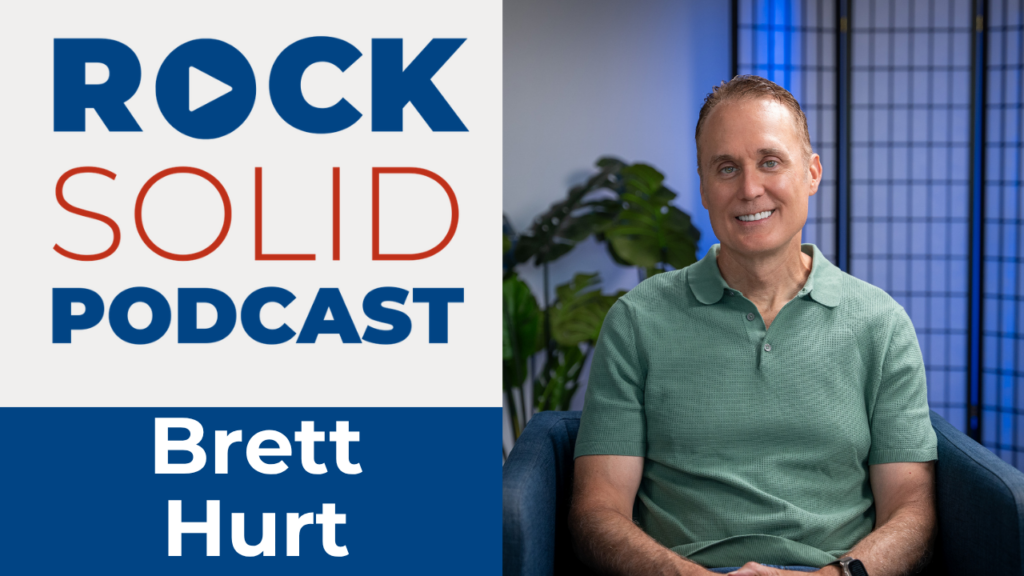
Brett Hurt founded Coremetrics, Bazaarvoice and data.world, and he and his family are seed backers of 12 unicorns. Then he wrote a book about love. In this Brett Hurt entrepreneur podcast conversation, he asks a question that sounds simple until you try to answer it: since when do we walk into a business and check love at the door? Read more about Brett Hurt and his new book, Love Conquers Fear: Humanity, AI, and the Age of Abundance for All.
This one is personal for me. I was living in New York and thinking about moving to Round Rock, and I called Brett to ask what it would be like to bring our kids here. I listened to him. Now Brett is back in Round Rock, where his grandparents lived near Brushy Creek, and I asked him to start with what it was like to grow up here.
His grandfather, a mathematics professor at UT, kept stacks of cash in that house and called it freedom. Then he quizzed young Brett on the most important thing in life. Brett’s answer was wrong twice before he got it right, and that lesson runs through everything else we talked about.
From there we compare Austin with Silicon Valley, and Brett explains why the first question people ask each other tells you what kind of place you are in. We get into why he thinks the best time to move to Austin is right now, how he would use AI if he were a plumber, and what he believes a machine can never give you as an adviser.
Near the end he tells a story about an Uber driver and a favor he wishes he had offered. I will not spoil it, but it changed how I think about what one conversation can do. For Round Rock leaders, the takeaway is practical: ask about the person first, then talk about the business.
Key Takeaways From This Episode
- Ask about the person first: Brett says people in Austin tend to hold the “what do you do” question until much later in a conversation, and that in Silicon Valley it was often the first thing people asked.
- Freedom has a different price tag: His grandfather saved and spent well below his means, and Brett says that is what let him do whatever he wanted.
- Do the work you love now: Brett says the classmates who planned to get rich first and do what they loved later did not become entrepreneurs.
- Use AI as your adviser: Brett suggests asking ChatGPT for a six-week course built around your own zip codes, with videos to watch and tests along the way.
- Keep the human part human: He argues that our memories, our relationships and moments like a Grand Canyon trip without phones are what machines will not replicate.
- Fix the incentives, not capitalism: Brett says he is not down on capitalism, only on the kind that knowingly puts profits over people.
In Brett’s Words
Since when do we go into any environment and say let’s check love at the door? We are full-bodied human beings having a human experience, and that includes with business.
Brett Hurt, founder of Coremetrics, Bazaarvoice and data.world
Most of the people that I meet here don’t ask me even what I do until much later on in the conversation.
Brett Hurt, founder of Coremetrics, Bazaarvoice and data.world
I’m not down on capitalism. I’m just down on the type of capitalism which knowingly puts profits over people.
Brett Hurt, founder of Coremetrics, Bazaarvoice and data.world
Episode Chapters
- [00:00] A phone call from New York: Bryan on the call to Brett about moving his family to Round Rock
- [01:20] Growing up in Austin: A grandfather, stacks of cash and the most important thing in life
- [04:08] Hot, hotter and weird: Brett on Austin’s three seasons
- [05:03] Why now is the best time to move: Marco Polo memories and the case for Austin
- [07:23] Silicon Valley versus Austin: The question people ask first
- [08:24] From online retailer to data.world: Coremetrics, Bazaarvoice and a decade of company building
- [09:23] Programming at age 7: Tech meetups and the Austin water he swam in
- [10:28] Manifesting love as a capitalist: Building a company culture that brings out the best in people
- [11:02] Check love at the door: A culture conference and a question that stuck
- [12:04] The classmates who never started companies: Why getting rich first is mostly an illusion
- [14:30] Writing Love Conquers Fear: Trusting your gut and leading from the heart
- [19:54] Breaking out of the matrix: Profits over people and the fear-based mind
- [20:54] AI and the plumber: A six-week course on the smartest adviser you ever met
- [23:05] Only 25 percent are positive on AI: Fire, The Matrix and old stories about technology
- [24:53] What AI cannot deliver: The human piece of advising
- [29:41] Chad and an Uber driver: Starting with the hardest problem
- [31:08] The missed opportunity: What a good friend told Brett he should have done
- [32:03] Conscious capitalism: Love must conquer fear
- [34:10] The next arc: Investing only where abundance for all is the goal
- [38:15] Hope and public benefit corporations: Why Brett is hopeful
- [40:18] Where to find Brett: The book, the audiobook and the Love Conquers Fear podcast
Frequently Asked Questions
Who is Brett Hurt?
Brett Hurt is an Austin native and serial entrepreneur who founded Coremetrics, Bazaarvoice and data.world. He says he is a seed backer of 12 unicorns. He is the author of Love Conquers Fear: Humanity, AI, and the Age of Abundance for All, which he says became a USA Today bestseller.
What is Love Conquers Fear about?
In the episode, Brett describes the book as his love letter to humanity. He argues that AI, quantum computing, robotics and brain-computer interfaces could bring abundance to everyone, and that we need to choose well to get there. He says readers come away with hope that is clear-eyed about the risks.
How does Brett Hurt compare Austin with Silicon Valley?
Brett says people in Silicon Valley often asked what he did right away and judged whether he was worth their time. In Austin, he says, most people do not ask until much later in the conversation. He repeats a friend’s line: New York is where you go to move fast, San Francisco is where you go to get rich, and Austin is where you go to be authentic.
What is Brett Hurt’s advice for using AI in a small business?
Brett suggests treating ChatGPT like the smartest adviser you have ever met. His example is a plumber who asks for a six-week course built around their own zip codes, complete with videos to watch and tests along the way. He says the same approach works for a church, a synagogue or any other business.
What is Brett Hurt’s connection to Round Rock?
Brett’s grandparents lived in Round Rock, in what he recalls as the Brushy Creek neighborhood, when the area was remote. His grandfather was a mathematics professor at UT Austin. Brett says some of his best childhood memories are of his grandmother’s garden there.
Where can I find Brett Hurt’s book and podcast?
Brett says loveconquersfear.org has everything. The free Love Conquers Fear podcast released weekly and had 67 episodes at the time of recording. Brett also narrates the audiobook himself.
About Brett Hurt
Brett Hurt is an Austin-born entrepreneur, investor and author. He founded Coremetrics, Bazaarvoice and data.world, and he is the author of Love Conquers Fear: Humanity, AI, and the Age of Abundance for All. He hosts the Love Conquers Fear podcast.
Connect: LinkedIn | loveconquersfear.org | The book
More From Rock Solid
If this episode resonated, hear Kasey Jorgenson on Prepping for Panic and Judge Steve Snell on Running a Tripling County. Both look at how Round Rock leaders handle change. Meet more guests in the Round Rock leaders directory and browse more leadership conversations.
Watch or Listen
Full Episode Transcript
Click to read the full transcript
Auto-generated transcript, lightly cleaned. Speaker changes start a new paragraph. Bracketed notes mark names that could not be verified and passages that are summarized.
Welcome to Rock Solid, the Round Rock Business Leaders podcast. Join your host, Bryan Eisenberg, as he explores the journeys of entrepreneurs and companies across Round Rock, Texas. From startups and nonprofits to large organizations, each guest shares their passion for doing business in this thriving community. Let’s dive in. Hi everybody, it’s Bryan Eisenberg and welcome to Rock Solid. Today is a very special day because I probably wouldn’t be sitting here today if it wasn’t for my good friend Brett Hurt. I don’t know if you remember when I was back in New York and thinking of moving down here. Obviously, I had my connection with Roy Williams, but I called you about what it would be like to move down here with our kids and stuff like that. And that advice, I listened, and obviously it’s come around full circle, and of course you’re an Austin native whose grandparents lived here in Round Rock. So I guess we have a full circle moment here too.
Well, now you’re selling me on moving to Round Rock. [laughter]
All of what’s happening here is amazing.
There’s a lot. But maybe we get you to come visit. I don’t know if you’d want to leave your beautiful home.
Yeah. But…
But at least come visit more often.
To see Round Rock booming.
Yeah. Let’s actually start there. What did it look like when you were growing up? Because we’re about the same age.
Well, my grandfather had a huge imprint on me, [unclear: James Manhur], and he was a mathematics professor at UT his whole career except for one year. He went to USC and he’s like, “Okay, I need to get back to Austin.” He grew up during the Great Depression, oldest of all the children in his family, and his father deserted the family due to alcoholism. He then helped raise the family, so he had a very low risk tolerance, and he ended up being a professor his entire career in mathematics.
He was very good at saving. He was very good at managing his money. He would show me stacks of hundreds in that Round Rock house, and he would be like, what is this? And I’d be like, clearly it’s money. He’s like, no, this is freedom. Then he would say, “What’s the most important thing in life?”
Wow.
And I said, “Are you gonna tell me it’s money?” He’s like, “No, guess again.” I was like, are you going to tell me it’s family? He’s like, “Nope. It’s not family either. It’s health. If you don’t have your health, you can’t enjoy money or your family or take care of them or enjoy any freedom.”
Right.
And so he lived here in Round Rock when it was truly remote. There was nothing here. I think they were one of the first houses in the neighborhood they were in. If memory serves me right, it was the Brushy Creek neighborhood. But he really loved living out here. And my grandmother was just such a phenomenal gardener. My best memories with her were being in the garden, her happy place, and seeing the ladybugs and everything else. It gave me a real appreciation for nature. But at the same time, I was like, it’s really hot in the summer.
It is definitely very hot in the summer to be doing some of that lawn care.
But I grew up in Austin and I used to have feet that were so resilient to the heat that I would play kickball on the hot asphalt without shoes on. I can’t even imagine doing that today. I’d be going to the hospital. I think about my poor dog when I walk him at night now. He’s gotten older. He’s now 10. He came back one night this past week, the first weeks where it started really being hot and humid at night, like 94, 95, and he spasmed up. The only thing I can attribute it to is that the heat just overwhelmed him. I do believe climate change is real, as I talk about in my book, but I also will tell you it was freaking hot when I was a kid here growing up, too. [laughter]
So hot. Well, as I always tell people who ask me about Austin, we’ve got three seasons here. It’s hot, hotter, and weird.
Right.
And weird could be a 30 or 40 degree difference in a day. We can have ice in the morning and 60 degrees in the afternoon.
I’m a little bit more slanted in the way that I say it. I say, look, it’s nice nine months out of the year here, because we do have something like 270 days of sunshine.
Or close. Between that and like 300 depending on the year.
Most of the year it’s actually pretty moderate. It’s just summer. Do not try to recruit someone here in August or September.
But that’s why South by Southwest happened in March and we saw that grow. One of my biggest questions for you, because I’ve known you longer than I’ve known my wife, or just about. It’s 24 or 25 years that we’ve probably known each other, back in New York City. It was Marco Polo.
Yes.
Great Italian food there. Red wine, fettuccine.
Yep. Yep.
And I know you sold the accolades of moving to Austin back then. What would you tell people today calling about moving down to Austin and Round Rock?
Well, I would say that it’s the single best time to move here, and that’s not from any kind of, hey, I’m desperate for the real estate prices to go up or anything else. It’s just true. You have the largest IPO in world history, SpaceX, which raised $75 billion. The next closest IPO was Saudi Aramco, which is state-owned in Saudi Arabia, which raised 25 billion. The IPO before that one was Alibaba, which raised 21 billion in China.
Um, so…
You have a tremendous amount of deep tech knowledge coming online, and it’s not just SpaceX. It’s [unclear: Paradmics], Icon 3D housing, and Atronic [unclear], which raised a $934 million Series A because they bootstrapped the company for the first 10 years. That’s not a very well-known story. So you’ve got real deep tech know-how accelerating here, the world of us being able to manipulate atoms versus just bits. And Austin is also a big part of the consciousness awakening as well. There’s a lot around…
Starting with Whole Foods.
Starting with Whole Foods. Absolutely. There’s so many things going on here. I would say that as an Austinite, being born and raised here, since 1972, seeing Willie Nelson perform at age four at a backyard barbecue, it has maintained its soul. It really is a community where people are trying to lift each other up. It’s not a community where people are judging you immediately based on your podcast or what you do. As a matter of fact, most of the people that I meet here don’t ask me even what I do until much later on in the conversation. Whereas when I was living in Silicon Valley with Deborah, the first thing typically people would ask me is what do I do. And they were immediately judging on whether or not I was worth any time at all. It was very transactional, and that just is not the way that Austin’s wired. One of my good friends, [unclear: Bedroywami], had this great line where New York City is where you go when you want to move fast, really hustle. San Francisco, the Bay Area, Silicon Valley, is where you go when you want to get rich. And Austin’s where you go when you want to be authentic. I always love that, and I think that extends to the surrounding areas.
One of the things I’ve definitely noticed is that Austin has always valued that balance of work and life. It wasn’t just one or the other. New York was always so busy, and here there’s always a better balance from a work culture. I definitely want to go into that a little bit, because you’ve been the CEO of a few successful companies. Give people the background who don’t know you. You had your own online retailer, one of your early companies, but then that morphed into Coremetrics, which is where you and I first met in the very early days of the analytics world of online marketing as a service.
Yep. Very, very early days.
And then of course you became the founder of Bazaarvoice, which became a unicorn, and data.world, which you sold just about a year ago today.
It was a year ago to this week as we’re recording this. Yeah.
So you’ve had a tremendous career of building companies. What has growing up in this environment helped you as an entrepreneur?
Well, there were two things. One, I started programming in 1979 when I was 7 years old, and I didn’t realize it because I was just a fish swimming in the water of Austin. But back then, the water included tech meetups where people would get together to learn how to program with each other. There were people like the Bitmap Brothers, who went on to be video game famous, and I was the youngest guy there. My mom would drop me off at those and they used to call me Mickey Mouse because I hadn’t hit puberty [laughter] and so I had a high voice. That was also the handle my New York City friends gave me on BBS land and stuff like that.
Which was endearing, but a little bit punishing.
Yeah. So that was an advantage. Now why did Austin have that? It had that because of UT Austin getting the original Cray supercomputers, people moving here, starting tech companies. The other thing is that Austin really put that sense in me of lifting each other up, and a big part of what I’ve always been trying to do as a capitalist is manifest love. Bazaarvoice was rated the number one company to work for in many years when it was small, medium, and large. data.world was rated in the top places to work every year since inception. What I was very deliberately trying to do there was create an operating system that would bring out the best in me and others. And I was speaking at this conference recently, this culture conference, which, shout out to [unclear: Eugene Sulva]. It’s become the worldwide gathering for discussing company culture. I was on stage with [unclear: Saul Rashidi], who’s the world’s first chief AI officer and an amazing woman. She’s on my Love Conquers Fear podcast. We were talking about love and it was just totally natural, and so many people came up to us after our talk and they were like, oh my gosh, I’m so happy I’m at a business conference talking about love. And I said, well, since when, this is 2026, yeah, since when do we go into any environment and say let’s check love at the door? We are full-bodied human beings having a human experience, and that includes with business. And so if you’re in an environment where they’re like, hey, this is not the environment where love counts, then I would respectfully say that you’re in the wrong environment, unless you’re really just there in this capitalist mindset of, I need to get rich as fast as possible to do what I love.
But I would say that’s mostly an illusion. I graduated with a lot of people from Wharton, where I got my MBA. I went to undergrad here at UT Austin, where they would say, “I’m going to do what you’re doing after I get wealthy.” These are people I graduated with. And I said, “What are you going to do now?” And they’re like, “Well, I’m going to go work for this investment banker and I’m going to make millions of dollars and then I’ll have the backstop of millions of dollars.” And I was poor for at least eight years after graduating from Wharton, and none of them became entrepreneurs. Not one.
Wow.
Because when you’re doing something that you hate to do, it sucks the soul out of you. So you reward yourself in other ways, and guess what? You’re going to buy a bunch of material items you don’t need. You’re going to accumulate, and you’re going to do the opposite of what my grandfather did. My grandfather became a multimillionaire because he spent way below his means, and he saved and he saved and he saved, and he had that financial security. He had that freedom to do whatever he wanted to do, and he really put that in me. There’s no amount of money you can make where you will not feel poor if you live a certain lifestyle. There are billionaires who have $380 million houses all over the place. Warren Buffett lives in the same home for decades. He’s actually my favorite leader in capitalism because he is the embodiment of love. I could tell you lots of Warren Buffett stories. I’ve had the honor of getting to know him and also going to the Berkshire Hathaway shareholders meeting multiple times thanks to Phil Terry. You know Phil Terry? I was just in New York City at Phil Terry’s 60th birthday, marching in the pride parade, where, if you want to feel a real high, go march in a pride parade. There were over a million people cheering us on. The energy of that was just off the charts, and Phil was like a dolphin in water. He was so happy.
Just jumping for joy, literally.
Yeah.
I’m curious because I’ve known you so long. You just finished releasing Love Conquers Fear, June 23rd. Humanity, AI, in the age of abundance…
For all.
Don’t forget the “for all.”
For all.
And you published your Entrepreneur Essentials about three and a half, four years ago.
Three years ago.
But you’ve been an entrepreneur pretty much your whole life. Knowing what you know now, knowing what you’re seeing about where the future is going, what do you wish early entrepreneur Brett knew then that you know now?
The big thing I would say is to really trust your gut instinct. I know the science behind this now. A lot of people in the AI space think that trying to replicate sentience is just in the brain. And we know that you have neurons all over your body, and the second most neurons you have are actually in your gut, and the third most are in your heart. There’s a lot of intelligence in that. You can feel when you’re leading from the heart. So I would say to trust your gut. There were a lot of times where I was the youngest person in the room until I wasn’t, and I would just say, well, what do I really know, they’re 15 years older than me, but I felt like it was wrong. When I started to trust my gut, that’s when I knew that love was the most important thing that I was looking for. I used other words back then. I would talk about passion. Are they truly passionate about what we’re doing? Would they run through walls to do it? Is this really their soul song? I would say things like that. But eventually I distill it all down to leading with love. Living a life in a very love-forward way is just the best way to live. That’s the secret that Warren Buffett figured out. He truly loves what he’s doing.
[The next few minutes of the conversation cover a Warren Buffett story, money and happiness, and a cautionary example of the comparison game. These details were not verified against outside sources and are summarized here rather than reproduced.]
We have created the matrix. We need to break out of it. The matrix that we’ve created is profits over people and the constant hijacking of the fear-based center of our mind, our amygdala. It includes that scarcity mindset. It’s in pharmaceuticals, it’s in food. There are toxins in our food that keep us chemically addicted, and then, by the way, there’s GLP-1s. There’s a solution. There are politicians telling you that we’re all going to go dystopian if you don’t vote for them. There’s the media pushing constant fear on you to keep you clicking. Social media is always trying to entrap you so they can sell more ads. It’s very big business. Very profitable. Meta prints money.
It literally prints money. Your book, Entrepreneur Essentials, came out right before ChatGPT opened up to the world.
What timing, huh?
Over the last few years, AI has had a huge impact. I think of entrepreneurs like my friend Bill and Brent, who owns Round Rock Studio. Maybe they haven’t reached the level of success that you have, and AI is coming in. What do they do next to make sure they’re successful? If you had to revamp Entrepreneur Essentials, what’s the essential that’s missing in today’s world?
Well, the key thing is, let’s just talk about if you had an advisor, and that advisor was the smartest person you ever met in terms of book smarts, and knew every scientific paper backwards and forwards, knew every spiritual text, every philosophical text, all historical text of any type. And you could ask that advisor any question at any point about your business, about your social life, anything.
What would you ask?
And we’re at that point. So if I was a plumber right now, I would go on ChatGPT, and I would be a very ambitious plumber because I’m wired for ambition. I would say, how can I be the best plumber in the world, or in this area of zip codes? And give it the zip codes. Can you create a six-week course for me, complete with videos I should watch, and then test me along the way? And in six weeks I would be transformed as a plumber. You could do that for any business you could think of. You could do that for a church you’re running, a synagogue you’re running. You could do that for anything. And you should do that. If I was rewriting Entrepreneur Essentials right now, I would have a specific chapter on AI and the leverage of that tool, but I would still say make something completely human. Now that doesn’t mean be afraid of AI. It’s really shocking, but it makes sense if you think about the programs running in our minds and the programs pushed on us, that only 25 percent of Americans right now are positive on AI.
That’s kind of crazy.
That would be like you and me discovering fire in the tribal days and being so afraid of fire that we don’t cook our food and we don’t warm our homes. But at the same time, look, the programming is The Matrix and The Terminator, and these stories are as old as time, as I talk about in the book. We’ve had these stories running for a long time that we will create something that destroys us, and those stories have a utility. The utility is to realize that all technology can be used for good or bad.
Correct. And it’s interesting, because 75 percent of Americans also don’t read a book after they graduate school. So there’s the concern about the AI part and being educated, but 100 percent of Americans know how to talk, and literally all they need to do is talk to it and ask any question they want, including summaries of books they might be interested in.
Well, it’s been trained on all of my books. Entrepreneur Essentials, I think, was the first book that you could chat with. Literally the day that OpenAI came out with custom GPTs, I uploaded the whole book for free just to do that. So people can still find that.
It’s interesting, because you talk about it as a very specific mentor or adviser, and I was fortunate enough to be one of your advisers with Bazaarvoice.
That’s right. You’re a great adviser, too.
What’s the piece, and I want people to hear this, what’s the piece that AI can’t deliver as an adviser that an in-person adviser actually does?
The human piece, the piece that makes us most human. The wonderful thing happening right now with AI is that we’re riding up this exponential of exponentials, what I call the super effect in the book. AI, quantum computing, robotics, and brain-computer interfaces will allow us to manifest abundance that we cannot imagine for everyone on the planet, if we don’t destroy ourselves. My book is my prayer, my manifesto, my love letter to humanity to try to make sure we don’t do that, that we choose well. The parts of humanity that we value the most, our consciousness, all of the memories we have, all the sensory experiences we have, seeing our child walk for the first time, the first time we fall in love, our wedding day, all of the best experiences. These are the most human things, and human beings have a lot going for us. We have an energetic field. We have a soul. We are souls having a physical experience, and that is not something that machines will replicate. That’s why I write in the book about one of the most magnificent trips I’ve ever had in my entire life, the trip last August in the Grand Canyon. If you haven’t done that, it’s really great. Cell phones don’t work. There’s no electricity. There’s no flushing toilets or anything. And what happens anytime you’re in that type of experience with fellow human beings is it’s not Lord of the Flies. It becomes this beautiful communion. The indigenous people knew that. They knew how to use their bodies and minds better than we do today. Rediscovering that is where this is going. Once we have energy abundance, and so much abundance that we’re not fighting over artificial resources, this scarcity mindset makes sense if you think about it, because we didn’t have electricity for 99.9 percent of our evolutionary time as Homo sapiens. Once we transcend that, all that’s left is the beautiful humanness.
[The conversation then moves through a long stretch on abundance, solar energy and space, including the James Webb telescope, quantum entanglement and satellite solar power. Summarized here rather than reproduced.]
You could replenish a country like Chad, where only one in eight people today have electricity. I personify Chad in the book. As a technologist, it’s a way of saying let’s start with the hardest problem, one that people can’t imagine. Chad is, unfortunately, called the dead heart of Africa by some because of how much scarcity they have. They can’t even imagine what we have here. And as you know from the book, I met an Uber driver named [unclear: Calibu] who was just marveling at all the abundance we have and praying that eventually he’s able to move his family here. But what if we could create Chad where he doesn’t need to move at all?
That was actually where I wanted to go, because in your book you talk about all the TED events that you’ve attended and the biggest impacts you’ve seen. But what struck me was [unclear: Calibu]’s story. That’s the one that stuck with me, because it’s that one-to-one, that one individual. You took this Uber driver and helped transform the way he’s thinking, because it wasn’t about bringing his family here to see the abundance we have. It was, what if he could plug into AI and use that to transform his home country.
Yeah. I mean, I missed an opportunity, though. [unclear: Byron Ree] actually told me that, and he was completely right. He’s a good friend, and good friends will tell you when you need to be told things. He’s like, you could have offered to pay for it. It’s totally true. So if he’s listening to this, come contact me. I’ll pay for your ChatGPT.
By the way, I thought of the exact same thing.
It was a totally missed opportunity. There are many times in my life where I’ll give to a homeless person when they ask for money. I wish more of them had Venmo or Zelle or something, because I almost never carry cash. But I missed an opportunity there. I hope that I had an imprint on him, because what a magical connection we had. You know when you meet someone and you just know you’re meant to meet them? He changed my life by helping me visualize what the solution would be for a country like Chad, and it has to be through technology. If you go back 250 years, 90 percent of humanity didn’t know how to read and 80 percent lived in abject poverty. So a lot’s changed. I’m not down on capitalism. I’m just down on the type of capitalism which knowingly puts profits over people. It’s a lazy form of capitalism. It’s like, let’s hijack the body and the mind for its weak areas to just make money-printing machines. That’s not the way to do capitalism. The right way to do capitalism is conscious capitalism. Realizing that we’re 99.9 percent genetically identical. We’re sharing a planet with a certain amount of resources, and we should care a lot about this jewel of a planet in this infinite ocean of a cosmos and take care of it. The planet is going to continue to respond if we don’t. I think we’re going to create a healed jewel of a planet, but we first have to start with upgrading our own consciousness and realizing that love must conquer fear. That’s in all the spiritual texts. It’s in all the philosophical texts. If people don’t believe in God, they’re triggered when I say that. It’s in stoicism. It’s what we have to do, or we’re just going to be constantly whipsawed by the constant deluge of toxins and negativity coming our way.
You’ve had this journey, and I heard it in the book. I pay a lot of attention to the words that are being used, and you called yourself a capitalist, a techno capitalist, a conscious capitalist. There were so many versions of that. That stood out to me. Coremetrics was more of a standard company. Bazaarvoice, and data.world was a B Corp. Now you’re doing Love Conquers Fear as your next one, plus your family investments. What’s this next arc looking like for people who want to understand how your capitalist mind has converted?
Well, I’m still doing investments, and I’m looking very closely at whether I really believe these are going to help us get to abundance for all. I only invest in a company if it really feels right to me. I’ve made plenty of money. Money is just a form of energy. If I make more money, I’m just going to use that energy for good. There are a lot of people who use money for energy that goes very wasted. The only form of happiness that’s lasting is found on the inside. Christianity says the kingdom of God is found within. Judaism is all about let’s repair the world together. And I’m very fortunate in that a lot of investments have really worked out. We’re seed backers for what are now 12 unicorns. We were early in SpaceX. There’s a bunch of things we’re in. But at the end of the day, the thing that matters the most to me now is let’s be the light for each other to help us create heaven on earth, because I really think that’s possible in this lifetime. And I think it’s this lifetime where we discover whether or not we can do that. A lot of people don’t believe we can. A lot of people are very negative on humanity.
A lot of people have invested in us not doing it either.
That’s true. But I love humanity. I really love all of us. That doesn’t mean I would invite a terrorist into my home. It just means that I think we all are part of God and we all have that divine soul. Unfortunately, the programs running in our minds, and that are constructed, you know, if you’re a terrorist you tend to be born into an environment which programs you that way. But there are a lot of examples of terrorists that broke out of that construct, and a lot of examples of Americans that broke out of that construct. I cover all that in the book, including a chapter on the objectification of women. We’ve had millennia of suffering because of that, and that’s where a lot of the othering comes from, the punching down on others. We can transcend these things. I give a lot of examples in the book on why you should believe we can, and why, when push came to shove, we really made the right decisions. During the height of the Cold War, I cover that, we contained smallpox, eradicated it, and we’ve almost eradicated things like polio. It brings me a lot of joy.
It brings me a lot of joy to see your transformation. In today’s world, people go around with a lot of fear, and change is always scary for almost everybody. My friend William Lamb is also big on upgrading humanity, and there are a lot of common themes here.
We’re in the most rapid change ever, and I think Love Conquers Fear does one thing above everything else: it gives people hope, of where the world could go if we just make a few more of the right choices. If more leaders like yourself step up.
I think they are. OpenAI and Anthropic are the fastest-growing revenue companies in human history, and they’re both public benefit corporations. The PBC as a legal construct came out of B Lab, which created the certified B Corp movement. They said, how can we do this even if people don’t want to be certified? It started in Delaware, and they changed the world. Now you’ve got the two fastest-growing companies ever choosing to say we’re going to be conscious capitalists. You could debate whether or not they are, but at least they’re making a step in that direction. And then you have Dario Amodei writing pieces like The Adolescence of Technology, which is amazing. You did not have this at the beginning of social media, where people like Mark Zuckerberg were writing about how this could have a bad societal outcome. But you have that with the AI leaders, whether it’s Dario, Mustafa Suleyman, Demis Hassabis, Dr. Fei-Fei Li, or Mira Murati, and on and on. You’ve got a lot of really good things happening now to say let’s meet this moment with a lot of intentionality.
I want to thank you so much for the intention of showing up here today, coming back to Round Rock, where the world has really changed since your memories coming out here. If people want to grab your book from Amazon, the audiobook is phenomenal.
It became a USA Today bestseller.
Congratulations on that.
That was unexpected and really awesome.
Well deserved. And if people have more questions, want to connect with you, hear more of your podcast everywhere else, where’s the best place for them to find you and connect with you?
Well, loveconquersfear.org has everything. The Love Conquers Fear podcast, which is free, has 67 episodes as of this recording. It releases once a week. I’m now doing a reflection series decoding different topics I’ve covered, because I’ve learned a lot. The podcast now is more than five 24-hour days of content. That’s a lot for people to contemplate going through. I would encourage them just to look at the titles and the people and see what calls to them. We’ve had a mix of spiritual teachers, our good friend [unclear: Mitch Jo], don’t miss that one. All types of capitalists, all types of scientists have been on there, and that’s been by design, because I’ve wanted to learn from as many people as possible and have people learn alongside. The podcast, everything is on there. The book’s on there. I did read the book myself on Audible, which is the hardest public speaking job I’ve ever had in my entire life. The person who wrote the foreword, [unclear: JD Messenger], and the person who wrote the afterword, [unclear: Mark Gober], also went into the studio. So we really try to produce a great product. I’m getting a lot of feedback every day from people who have read the book, and it does overall leave people feeling a lot of hope. Not hope because it’s Pollyannish, but hope because it’s very clear-eyed on what the risks are and why you should believe in us.
And how to avoid those landmines that are in the way. So again, thank you so much for your time today.
Thank you, brother.