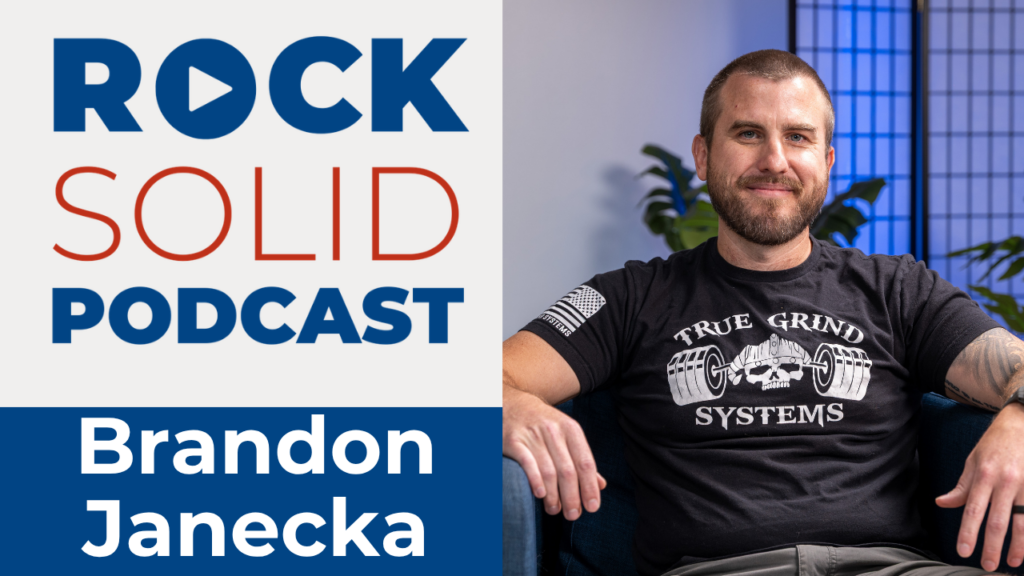
A 12-year-old keeps asking his trainer about his foot angle in the middle of a timed drill. Brandon Janecka gives him one sentence to say out loud before the next rep. What happened next you can hear at 15:45 of this episode.
Brandon Janecka is a Leander sports performance coach and the founder of True Grind Systems. He trains athletes from across the greater North Austin area. Host Bryan Eisenberg’s son Sammy has trained with him for nearly a decade, and past guest Matt Kata’s kids train there too.
In this conversation Brandon explains why he thinks performance has three pillars and why almost nobody is talking about the third. You will also hear what he told a softball player who said “it’s fine” after her name was left off the lineup, and what he says to parents who want to help.
What You Will Hear
- A third pillar. Brandon adds belief to body and control, and says why it belongs in the same system.
- What to do with a setback. Why he sends athletes to sit with a disappointment instead of burying it.
- A parent’s job. What he thinks parents should protect, and what he thinks they should leave to the coaches.
- What keeps a founder going. Brandon on where his drive comes from, and the stretches when he nearly walked away.
Emotions are human … Your behavior from that emotion can be soft … But you being overwhelmed is not soft.
Brandon Janecka, True Grind Systems
With the mindset … it’s the adversity that we move through to flex that muscle, to grow that muscle.
Brandon Janecka, True Grind Systems
You’ve selected that environment. Allow it to work. You be the connection. You be the other side of that coin.
Brandon Janecka, True Grind Systems
Episode Chapters
- [00:00] Welcome to Rock Solid: The host introduces a guest who means a lot to his family.
- [00:34] Why this one is personal: Bryan explains what True Grind Systems did for his son Sammy.
- [01:47] Three Pillars: Body, Control, Belief: How a homepage rewrite turned into a new model of performance.
- [06:11] Beyond the Checkbox: Bryan on why the time Sammy spent in the gym matters after the cleats come off.
- [07:11] The Fastest Fastball Brandon Ever Caught: A question from Sammy about the fastest pitch Brandon ever caught.
- [10:43] The Softball Player Who Said “It’s Fine”: The belief pillar in action, and what Brandon asked her to do.
- [15:45] A 12-Year-Old and Permission to Fail: Why perfectionism slows athletes down.
- [19:27] What Drives a Founder Who Almost Walked Away: Brandon on insecurity, stress, and finding another gear.
- [25:15] What Parents Should Do Instead: The role of protecting the environment and being the connection.
Frequently Asked Questions
What is the belief pillar in athletic performance?
Brandon Janecka of True Grind Systems defines belief as an athlete’s identity: how they see themselves, how they see others, their confidence, and how they respond to mistakes and adversity. It sits alongside the body and the nervous system as the third pillar of performance.
How does emotional awareness help athletes perform?
Brandon explains that sports are reactive, and the conscious brain is too slow to read a curveball. An athlete has to trust the body, but a brain holding an unprocessed emotion tries to protect them and will not let go. Processing the emotion first helps that trust return.
What should parents of youth athletes do?
Brandon says a parent’s job is protecting the environment. Choose the team and culture, let coaches handle discipline and hard lessons, and focus on positivity, connection, and belonging.
What should an athlete do after being left out of the lineup?
In the episode, Brandon tells a high school softball player to go somewhere safe, return to that moment, and sit in whatever emotion shows up instead of running from it. Hear her results in the full conversation.
What does True Grind Systems do?
True Grind Systems is a sports performance facility in Leander, Texas that serves athletes across the greater Round Rock area. Brandon describes its goal as increasing performance and decreasing risk of injury. You can learn more at truegrindsystems.com.
About Brandon Janecka
Brandon Janecka is the founder and owner of True Grind Systems, a sports performance facility in Leander, Texas that serves athletes across the greater Round Rock area. He grew up in Austin playing baseball, studied kinesiology, and started his own company after working under another gym. Eleven years in, he describes performance as three pillars: body, control, and belief.
Connect: truegrindsystems.com | Instagram | Facebook
More From Rock Solid
For more on resilience and performance, hear Matt Kata on Becoming the Guy Every Team Needs, whose kids train with Brandon, and Jenn McPeak on Recovery Over Hustle. Browse all resilience and personal growth episodes or education and youth episodes.
Watch or Listen
Watch or listen to the full conversation with Brandon Janecka below.
Full Episode Transcript
Click to read the full transcript
Bryan: Welcome to Rock Solid, the Round Rock Business Leaders podcast. Join your host, Bryan Eisenberg, as he explores the journeys of entrepreneurs and companies across Round Rock, Texas. From startups and nonprofits to large organizations, each guest shares their passion for doing business in this thriving community. Let’s dive in. Hi everybody, it’s Bryan Eisenberg and welcome to Rock Solid. Today I am joined by a very dear friend, someone who means a lot to me and a lot to my family. Oftentimes I get guests on the podcast who I don’t know really well, but I have to thank Brandon Janecka from True Grind Systems so much, because today my son is 21 years old and he’s going to be the manager for the baseball store, the specialty store, at Scheels. I know I owe a ton of that to you. I remember way back, after the first summer grind that we did, and we haven’t done those in a long time, Sammy was, I think, just turned 12.
Brandon: Okay.
Bryan: And he went back to school and his teacher literally called us and said, “Did you swap kids?” Because they didn’t recognize him. Lots of parents care about their kids being athletic, right? And Sammy loved baseball, all of that. But what he learned through True Grind Systems and your gym is responsibility, servant leadership, just how to achieve goals and knock them out like they were nothing. My biggest question for you, and I know you can understand that now, hearing it from me, how much of an impact that’s had: now that you’re a dad, how do you view training kids differently?
Brandon: Oh man. It’s funny that this is where we start, because this is the exact subject I’ve been wanting to talk to you about personally, not even necessarily on a podcast. It probably started with my firstborn, but for the sake of this conversation, we’ll say this whole new thought process started last November when I was trying to build or refresh our website. I was trying to come up with something in the hero section that, in the simplest terms possible, explained what we do. Through serious thought, I came up with “we increase performance and decrease risk of injury.” In a nutshell, the broadest, simplest way, that’s what we get paid to do at True Grind Systems. That sent me down the rabbit hole of performance. What is performance? I was sifting through all the experience and knowledge I had to lean on, and I was able to categorize it into three categories. One of them is the body. That’s your muscles, bones, range of motion, force absorption, force production, your work capacity.
Bryan: And how you show up on the field.
Brandon: Yeah, and what you look like, for sure. Then we have your control panel. That’s your nervous system, the mind, the central and the peripheral nervous system. That is your proprioception, how you move in space, your balance, your reaction. But there was something missing. We knew we had the neurological system. We knew we had the body, and that’s what we’ve been training for a long time. But there was something more to performance that, through becoming a dad, becoming a husband, and just the drive to be better, a better dad and a better husband, took me down the emotional side of life. Understanding emotion, so I could become a better husband and a better father. Then I started connecting dots, and I was able to put emotional control, or emotional intelligence, under the performance umbrella. So we have three pillars: the body, the control, and the belief. This belief pillar is what I’ve been really diving into lately. That is essentially your identity: how you see yourself, how you see others. It’s your confidence. It’s your ability to overcome adversity and overcome mistakes. It’s how you see mistakes in the first place. It’s that intangible piece that I don’t think anyone is talking about. More specifically, no one is talking about all three in the same system.
Bryan: No, for sure. We’ve talked a lot about the gym environment, building that and training kids for years. We spent a lot of time in the same building for a bunch of things, and we’ll talk about that as well. But it’s so easy for me to look in hindsight. When Sammy was in the thick of trying to get to collegiate ball and going through high school, with the adversity he had, the injuries he had, the stuff with school, and going through COVID as a freshman, the main focus with him was that athleticism, right? And he wasn’t a naturally gifted athlete. He was just a big kid who had a big passion. And you helped turn him into an athlete. All great. That’s the checkbox I think everybody would expect a parent to have if I’m going to send a kid to do any kind of training. That’s the minimum standard. But now I get to look back at it and I’m like, okay, he didn’t finish college because of his injury, and he hasn’t gone back yet. He hasn’t dismissed it. But this opportunity with Scheels came up. A lot of people who don’t know what Scheels is, it’s a ridiculous store. It’s 300,000 square feet, 75 specialty stores, real experts in every category. They gave him the opportunity to be the baseball manager. I know without a shadow of a doubt that all the time he spent in the gym with you and the team transformed him into the young adult he is today. Any parent who thinks about their kid in athletics and only thinks about that aspect misses what happens when they hang up the cleats. He’s also been blessed to have some amazing mentors going through the gym, a lot of very professional athletes who have since retired. You’ve experienced some very interesting moments with those. Sammy wanted me to ask you because he figured it would be a fun question: what is the fastest fastball you caught for a big leaguer in the gym?
Brandon: Ooh, the fastest fastball I ever caught.
Bryan: Because you were a catcher in high school.
Brandon: I caught in high school. When I was playing, radar guns were a thing, but I think only UT and the Astros and the Rangers had them, so I don’t really know how fast I caught when I was playing. There was a guy I caught who was a closer for the Milwaukee Brewers, David Goforth.
Bryan: Great gentleman.
Brandon: Awesome dude, super funny. Love David. He was a 100 mph guy on the field. I was not catching 100 miles an hour, so my guess would be low nines. Very firm. Very, very firm for me.
Bryan: And without gear. Let’s also clarify that.
Brandon: The good thing about those guys, especially David, is that you pull your glove up and it’s going to be in the vicinity, so my job was relatively easy in that sense. Still coming in firm. But yeah, probably David Goforth. I faced Mason Thompson. I faced Mason Cole. Both of those guys are in the mid nines. Mason has touched 100 in pro ball.
Bryan: I heard that as well. That Mason is the one who made Sammy go [unclear] when he was 14 years old and said, “97 coming at my hip doesn’t feel comfortable. I don’t think I want to stay there.”
Brandon: Yeah. [laughter] I just watched Mason pitch with the Express.
Bryan: Correct. That was awesome. And again, he was one of those young kids when Sammy first got started, and you got to watch him progress and watch these kids go to the big leagues. You’ve seen kids you’ve trained in front offices. When you look at what you’ve accomplished with the people you’ve worked with over this year, what are the moments that really stand out for you, where you say, everything I do, this is why I do it?
Brandon: Okay. There have been a few this year because of this belief pillar realization. One of them is watching Sammy, actually. I’m so proud of that young man. I really think Scheels seems like an incredible company. They really treat their guys well. Time will tell, but where he’s at is an incredible place. With this belief pillar, two incidents came up. One of them was a junior softballer at Liberty Hill, a local high school. The summer before, probably seven or eight months before, she was one of the hardest workers, extremely consistent, very particular. When the preseason tournaments came along, I asked, “Hey, how’d the weekend go?” They had played a tournament that weekend, and she said, “Oh, I wasn’t in the lineup, but it’s fine.” And I said, “No, no, that’s not fine. That sucks. That’s a bummer. That’s okay, you worked hard and you’re not in the lineup.” I was feeling that while talking to her, because I’ve been in that situation. I’ve been expecting to be in the lineup and not in the lineup, and my heart sank. That’s a terrible feeling. She’s very hard-nosed, a very hard worker. So what did she do? She essentially never addressed it. I told her, “Hey, I want you to do me a favor. Go home and find a safe place, probably your room, and revisit that moment,” because I knew she hadn’t processed it yet. “Whatever happens, happens. If it’s tears, if it’s sweaty palms, if it’s anger, if it’s head pressure, whatever happens, go to that moment and sit in that emotion. Don’t run from it.”
Bryan: And she did.
Brandon: She did. The next tournament she got a little bit of playing time, and she came back and I asked her how it went. She went four for seven with two home runs, something like that, and I was like, oh man. She ended up being the four hole on a team that went to the Final Four, with a total of eight home runs after the end of the game. So she started that preseason out of the lineup, and with just this mentality of not running from emotions, not hiding emotions, because what I’ve realized is that society portrays emotions as soft, and I disagree. Emotions are human, right? Your behavior from that emotion can be soft.
Bryan: Correct.
Brandon: But you being overwhelmed is not soft. It’s real. Your body is sensing something. You quitting from being overwhelmed could be soft. But never addressing it, never processing these emotions, it stays with you.
Bryan: The body keeps score. My friend always tells me that. It’s on my read list.
Brandon: How I envision it is an emotional straitjacket starts to wrap around them, because I think what’s happening is the brain is trying to protect. You’re holding this emotion, the brain doesn’t like that and doesn’t want to go back to it because you’ve been running from it, so now it starts to take over. The problem with sports is that sports is very reactive. The brain’s processing speed is very slow, so the logical brain cannot see the spin of the ball, recognize an off-speed pitch, a curveball, a breaking ball, see the location.
Bryan: Imagine where it’s going to go.
Brandon: Imagine where it’s going to go. It just doesn’t happen like that. You have to be reactive, and being reactive means your brain has to have a level of trust and relinquish control out of the conscious brain into the body, or the subconscious brain. I like to call it the body. That’s the reactiveness of sports. But if you never process that emotion, your brain will not do that, because it’s trying to protect you. So it’s very important to be self-aware, to have emotional intelligence and emotional awareness, and not be afraid of that arena. That was a big moment. Then, really close to that talk, I was on a roll, I guess, and I’m very careful with how I present this to the athletes because I understand I’m dealing with very impressionable minds.
Bryan: Correct.
Brandon: I had a seventh grader, 12U, and he’s a very hard worker, a very perfectionist hard worker. He was doing an agility drill that was being timed, and he was asking me questions about his foot angle that were kind of insane. Not the kind of thing a kid that age usually thinks about.
Bryan: Correct.
Brandon: I was like, man, he’s trying to be robotic. And that’s another thing about the conscious brain: sports is an art form. It takes a level of creativity, and trying to be perfect removes that, which I want to talk about a little later. With this athlete, he was asking me these questions and he didn’t hit his standard times. So I laughed and said, “Hey, man, I want you to do me a favor.” His name is Alex. I said, “I want you to repeat after me.” He said, “Okay.” I said, “My name is Alex and I give myself permission to fail, to make mistakes.” And he laughed. I said, “No, seriously, do it for me.” And he said, “All right, my name’s Alex and I give myself permission to make mistakes.” I said, “Cool. Now relax. Have fun.” He lined up, and he got his personal record on that rep, just like that. And I was like, that moment really solidified that I am onto something. There’s something here, and it needs to be in our system.
Bryan: I’m going to tap you into a couple of other resources after we speak. You’ve had pro athletes, and we had Matt Kata on the podcast recently. He mentioned you as well. His kids train with you. You’ve had plenty of professional players, but also kids of other professional players. What do they know about why it’s so important to work with trainers like you at True Grind Systems that most sports parents don’t have a clue about?
Brandon: They understand that your naturally gifted athlete has a shelf life. It’s just a matter of time before puberty hits, before whatever level it is, that tank of natural talent is going to run dry and everyone else is going to be at that level. On top of that, with the updated sciences of strength and performance, and the injury risk, understanding the demands of the sport and the trauma that comes along with it, especially in a one-sided sport like baseball or softball, they understand breakdown is a very real thing. I’d imagine they have probably seen firsthand super talented people lose their career to injury. So they come to a place like us to…
Bryan: Safeguard.
Brandon: …to put that suit of armor on them.
Bryan: I want to switch gears a little bit, because I want to look at your entrepreneurial journey. I think there’s a lot to learn for our audience there. One of the things I admire about you is, first of all, your resilience, but second, that you’re always studying and always trying to improve yourself. I’ve witnessed the hardships. You obviously moved to a brand new location as COVID hit and everything shut down. That was a blessing for Sammy, because he got to do his school at home in the gym and helped put together some of the pieces in there. But you’ve also had partners who have let you down in more ways than one. It’s not just one partner, it’s a couple of them. We share one of those partners. So there’s that as well. But somehow through it all, you’ve always managed to regain your footing and stay resilient and find that next gear to kick the business into where it needs to be. What drives that?
Brandon: I think it’s an evolution of drives. Early on in my career, it was driven by insecurity.
Bryan: Okay.
Brandon: Especially the knowledge one. I just don’t know enough.
Bryan: You’re very, very humble. Years ago, yeah.
Brandon: And I really wanted to learn more. You say all that and I appreciate it, but there have definitely been times where I was one moment away from walking. It was fairly recently that I was putting in job interviews. It was less than two years ago that I was putting in job interviews, just because of the stress and anxiety.
Bryan: Yeah, it’s common.
Brandon: What drives it? Right now, what drives it is the kids that I can help, the potential kids that I can help. I believe the world needs the correlations I’m trying to make right now. It needs this emotional resilience and intelligence inside of sports. But yeah, that is a great question. The reason I hesitate is that it’s absolutely an evolution. At some moments I just don’t know any better. I fall back to work when I get so overwhelmed. The only thing I know to do is work. Even that takes me back to how I grew up, with my dad, who’s also an entrepreneur. Mom and dad both own a business. My dad is the oldest of six in a low-income family, and he’s been working since he was 10. That’s just what our family did, was work. That’s all I knew to do. Then the family came along, and that’s a whole other set of motivations and a whole other set of anxiety and stress. Yeah, man, that is a great question. I cannot give you a simple answer.
Bryan: Yeah. It’s not a simple answer. Entrepreneurism is messy, and everybody likes to talk about the big successes. Those are easy to talk about, but the real hardship, the failures, I mean, many, many years ago, in one of our very earliest businesses, we literally had a partner who locked the door on us. We drove from Brooklyn to New Jersey, and all of a sudden we got to the door and he locked us out of the business, and he took all the money from all the people we had helped pay for inventory. Believe me, it’s messy, but you learn and you grow from it, and you kind of find another gear to accomplish what you’re trying to accomplish.
Brandon: I wish I had it this whole time. But I think that’s a big piece of it, that growth mindset, seeing adversity, seeing this failure, this mistake, as a learning experience and not as a debilitating issue, but more as an opportunity, a resistance to getting stronger. Just like the body, resistance grows muscle. With the mindset and all that stuff, it’s the adversity that we move through to flex that muscle, to grow that muscle.
Bryan: One of my favorite analogies in the world, because it is one of the truest things I have ever heard, and I don’t even remember where I heard it first, is: owning a business is a lot like getting pregnant. Everyone sees the baby, but no one knows how many times you’ve been screwed. [laughter] That’s a reality.
Brandon: That is a reality. You see any business owner over five years, over three years, especially one that’s in its second decade or beyond, and mad respect. It’s hard.
Bryan: We’re coming up on time and we could speak for hours, but is there anything you think I didn’t ask you that the audience needs to know?
Brandon: Oh man, yes. [laughter] Where do I go with that? I think if you’re a parent of an athlete, the parent’s job is protecting the environment, making sure your athlete is in a good environment, and not so much being the dictator, and allowing them to be coached, but just making sure they’re in that environment and have the opportunities to succeed. I think athletes these days need more positivity and connection from their parents, and need to allow the coaches and the team and the culture you’ve selected for them to do the discipline, to do the hard lessons that are inevitable in sports. I think connection and belonging is a better role for a parent of a kid, especially one with high…
Bryan: Potential.
Brandon: …potential, or even high expectations, or high caliber, right? These elite teams, whether you’re nine or 19, they work. They have a standard, and you allow that standard to do its job. You’ve selected that environment. Allow it to work. You be the connection. You be the other side of that coin.
Bryan: Well, I thank you again for everything you’ve done for Sammy. Even now he leaves work and runs straight to True Grind. It’s his second home. Flip a coin, ask where Sammy is: it’s work, home, or True Grind. So thank you so much for everything you’ve done for him and continue to do for him, and for what you do for the community.
Brandon: Oh, it’s been a pleasure. I love it. Thank you.
Bryan: Thank you.