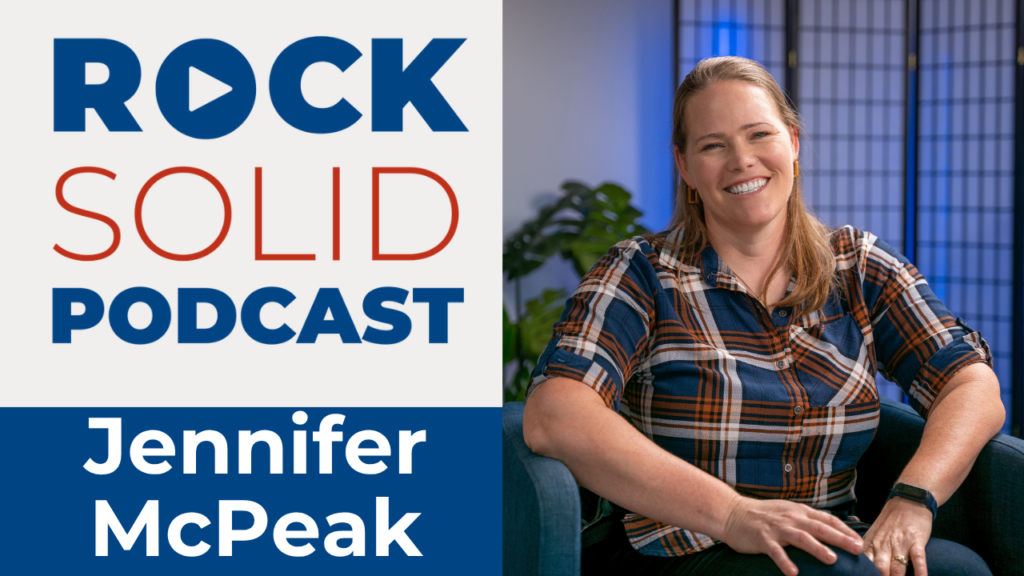
Jenn McPeak has watched Round Rock cut the ribbon on gym after gym after gym. Bigger equipment, harder classes, more reasons to push. So when she opened Evolve Social Wellness, she built the opposite. No pressure to perform. No trainer yelling about one more rep. Just a room full of people learning how to stop.
Jenn’s path here was not a straight line. She holds a master’s in marriage and family relationships and spent years in equine assisted psychotherapy, working complex trauma cases with teenagers at a boys ranch before her husband’s brother, a member of the original Evolve in San Antonio, asked if the family wanted to bring one to Round Rock. She told me on this week’s episode that Evolve turned out to be a back door into the same work. Nobody walks in asking to process their nervous system. They walk in for a cold plunge and walk out having done exactly that.
Here is the moment that every entrepreneur can relate to. Jenn admitted that even though she owns the recovery business, she still catches herself in the back office trying to knock one more thing off the list while her own stress climbs, and some days she takes the cold plunge and some days she just pushes through “because we’re entrepreneurs and we’ve got to do what we have to do.” If the woman who built the business still fights the pull of hustle, the rest of us do not stand a chance without a plan.
That is the real reason this episode belongs in Round Rock and not just on a wellness blog somewhere. Jenn is watching business owners hold their one on ones in a sauna that seats forty instead of at a coffee shop, and members who show up every single Friday afternoon for a reason she explains in a way you have to hear her say out loud. A local chiropractor we mention is running nervous system scans on fit twenty-somethings and finding the same red flags he used to only see in exhausted forty+ year olds.
So here is the question worth sitting with before you queue up the episode. If your calendar looks productive but your body is quietly falling apart, which one is actually telling you the truth?
Key Takeaways From This Episode
- Hustle culture rewards busyness, not results: Jenn names the trap directly, “the system kind of rewards people who are hustling,” and it is easy to tie your worth to constantly doing something.
- Recovery is not a reward, it is maintenance: The body does not grow while you push. It grows in the healing period right after, whether that is muscle, focus, or a business decision made with a clear head.
- You do not have to be an elite athlete to need this: Evolve’s members range from working professionals shedding the week on Friday afternoons to a veteran managing complex PTSD, proof that nervous system regulation is not a luxury item.
- Relaxed and energized are not opposites: Members repeatedly tell Jenn they leave feeling both calm and ready to go, a sign the body finally has enough of itself back to use, instead of the jittery version caffeine fakes.
- Round Rock business owners are already changing how they meet: Some now hold one on ones in Evolve’s sauna instead of a coffee shop, treating recovery as infrastructure for the local business community, not a personal indulgence.
Pull Quotes
“The system kind of rewards people who are hustling. And I think it’s easy to fall into that pattern of like, I have to be doing to feel good about myself.”
Jenn McPeak, Owner, Evolve Social Wellness
“I am 100% also so in need of evolve. When I’m at work I’m in the back office trying to knock something off, and I feel the stress rising.”
Jenn McPeak, Owner, Evolve Social Wellness
“When we’re more regulated, there’s going to be more of our minds to be creative, to find resolution and problem solving.”
Jenn McPeak, Owner, Evolve Social Wellness
Episode Chapters
- [00:30] Why Every New Gym in Round Rock Looks the Same, Except This One: Bryan notices a pattern in ribbon cuttings: bigger, harder gyms everywhere, except one space built around slowing down.
- [01:21] From an Equine Therapy Ranch to a “Back Door” Into the Nervous System: Jenn explains how her background in trauma-informed, equine assisted psychotherapy shaped a business that heals people who never asked to be healed.
- [07:28] “I Am 100% Also So In Need of Evolve”: Jenn admits she still fights the pull to push through instead of stopping, even though she owns the recovery company.
- [12:17] The Nervous System Scans That Shocked a Chiropractor: a colleague’s scans on fit twenty-somethings reveal the same stress patterns doctors used to only see in exhausted forty year olds.
- [14:13] A Wellness Playground With Four Cold Plunges and a Forty-Person Sauna: why Evolve stacked so many recovery modalities into one walk-in space instead of specializing in one.
- [19:50] Relaxed AND Energized: What Members Notice After Seven Months: sleep improves first, then something Jenn did not expect: people leave feeling both calm and ready to go.
- [24:32] Sauna Meetings and the Birthday Parties Nobody Expected: local entrepreneurs now hold one on ones in the sauna, and members book birthday parties instead of a bar.
- [26:02] No Appointments: How Round Rock Can Walk Into Evolve: location, hours built around working professionals, and how to visit for the first time free.
Frequently Asked Questions
What is Evolve Social Wellness in Round Rock?
Evolve Social Wellness is a walk-in recovery space at Hester’s Crossing in Round Rock, built around no-appointment access to a Norwegian sauna that seats 40, four commercial cold plunges, red light therapy, compression, and neurocognitive training. Owner Jenn McPeak calls it a “wellness playground” where members choose their own path through the modalities each visit.
Do you need an appointment at Evolve Round Rock?
No. Evolve is built on a walk-in model with no appointments required, open seven days a week starting at 10 a.m., and 6 a.m. on Tuesdays and Thursdays specifically for professionals who want to regulate their nervous system before the workday starts.
Why is recovery important for entrepreneurs and business owners?
Jenn McPeak explains that hustle culture rewards constant busyness, which leaves entrepreneurs stuck in fight-or-flight with no built-in off switch. Recovery restores the nervous system’s ability to regulate, which she says leads directly to clearer thinking, better decisions, and more creativity, not just physical relief.
What happens in a nervous system scan?
Bryan references a colleague, a nervous system focused chiropractor, who runs scans that measure stress load in the body. He is finding fit people in their twenties carrying the same red flags doctors used to see only in exhausted people decades older, evidence that visible fitness does not mean a regulated nervous system.
Where is Evolve Social Wellness located in Round Rock, Texas?
Evolve is located at Hester’s Crossing, where I-35 and US-45 meet, on the east side of I-35 directly across from Home Depot and next to Leslie’s Pool Supply. First-time visitors can come with a member for free.
About Jenn McPeak
Jenn McPeak is owner of Evolve Social Wellness in Round Rock, Texas, which she runs alongside her husband Isaiah. She holds a master’s degree in marriage and family relationships and spent years in trauma-informed, equine assisted psychotherapy before bringing a walk-in recovery model to Round Rock. She is a member of the Round Rock Chamber and is building Evolve into a gathering place for the local wellness community, not just a recovery vendor.
Connect: Instagram | Facebook | Evolve Round Rock website
More From Rock Solid
If this episode resonated, hear Why Round Rock Moms (and More) Are Finding Sanctuary at Cosmic Egg Wellness and The Round Rock Therapist Who Wants to Work Herself Out of a Job, both guests building a different relationship between this community and its own stress. Browse all Health & Wellness conversations on Rock Solid.
Watch or Listen
Full Episode Transcript
Click to read the full transcript
Bryan: Hi everybody, it’s Bryan Eisenberg and welcome to Rock Solid. This week I’m joined by my friend Jenn from Evolve Social Wellness. Thank you so much for being here today.
Jenn: Oh, it’s so great to be here.
Bryan: As part of the Round Rock Chamber ambassador, I’ve attended a lot of ribbon cuttings the last couple of years, and a lot of them have been for gyms. It seems our culture just wants to keep pushing people to work out harder, bigger gyms, greater gyms. But only one space I’ve been to said, “No, we’re not going to try to get people to push harder. We’re going to focus on social and slowing down and allowing themselves to recover.” I appreciate that as an entrepreneur, because it’s easy to follow everybody else in what they’re doing, but you decided we needed something else. Help people understand why you chose that.
Jenn: Oh man, okay, there’s a lot behind that. Honestly, I feel like there was a lot of God involved in it too, because I come from a different field entirely. My husband’s brother is a member of Evolve Human Optimization in San Antonio, loved the community and the experience, and he approached my husband and me about opening a franchise up here. That’s the short story of how it came into being.
Bryan: But you still had to decide that this made sense, when everybody thinks push, push, push, and you’re saying no, we’re going to slow everyone down. That’s against the grain.
Jenn: Yeah, no, for sure. My husband had always wanted to do a brick and mortar business. He’s done a lot of software business, more online work. I had run ranches before in my past for other businesses, though I can’t really call that brick and mortar. When he brought this to my attention and I went down to San Antonio and experienced it myself, I was able to get behind it, because it aligns with what I really want for people in general.
Bryan: Let’s explore that background a little, because you have a background in trauma-informed therapy as well as equine therapy. That’s all about helping people heal through nervous system dysregulation, the trauma, the experiences they’ve had, their nervous system not responding the way it should. What pattern do you see showing up with the people walking through your door that you’ve learned from all those years?
Jenn: Yeah, so to go into that background a bit, I went to school for marriage and family relationships and therapy, got my master’s, and went right into the work field helping teenagers. I worked at a boys ranch, and specifically went into equine assisted psychotherapy, which is very trauma-informed. We specialize in complex trauma cases. At the heart of trauma is your body having lost its ability to regulate and connect all parts of the body. The experiential nature of working with horses gives people lots of practice noticing when they’re disconnecting, because horses naturally feel unsafe when you disconnect from your body.
So we come into this space, and honestly, I feel like it’s kind of a back door into some of the same work. Somebody might not necessarily say “I need to resolve my trauma,” or even be aware of it. We all carry it, nobody escapes it. And the more we can be intentional about it, the more we can release, and that means there’s more of us to show up in our families, our workplaces, our goals and missions for our life. So a lot of people walk through our door because their body’s hurting, or they want to try the cold plunge thing, but even if they’re not aware of it, they walk out having come into their body more and finding some deeper regulation, and they feel the impact everywhere.
I love it when members come at the end of the week on Friday afternoons. These are just working professionals, and one in particular told me, “I hold out all week long for Friday afternoon when I’m coming to Evolve, and I’m going to shed the week and regulate and come into my body and be ready for a killer weekend by starting it with recovery.” Then there are people who are intentional about it because of mental health stuff going on. I talked to a veteran with complex PTSD who told me this helped him get to a point where he could be functional again in his life.
Bryan: We had Cara Powell from the Rock Ride On Center talk about their equine therapy, especially with veterans, and the impact on PTSD. One thing I know about equine therapy is you don’t control the horse from your words, you control it from your nervous system, that connection. Why are so many people struggling today to be in tune with where their nervous system is? They don’t have the horse next to them, but how do we help them understand that maybe that’s not working right for them?
Jenn: I love that question, and it’s very multi-leveled. I think in general our world has just gotten faster and faster, we’re spinning up, and the system kind of rewards people who are hustling, and of course rewards achievement, like you have to be accomplishing. I think it’s easy to fall into that pattern of like, I have to be doing to feel good about myself. I fall into that trap too, Bryan. I am 100% also so in need of evolve. When I’m at work, I’m literally in the back office trying to knock something off, or working on maintenance, and I feel the stress rising, that “got to go, got to go” feeling. That’s the moment I need to stop and go get in my swimsuit and cold plunge. On good days I do it. And other days we just push through, because we’re entrepreneurs and we’ve got to do what we have to do.
I think in general there just aren’t a lot of places anymore for us to slow down. Even the culture of just getting somewhere used to be slower, walking or riding a bike. Now everything is just fast, fast, fast.
Bryan: That triggers a memory for me. I grew up in Brooklyn, New York, concrete jungle. The park was a block away from me, and I vividly remember always seeing tons of people in the park playing chess, cards, bocce ball, a real social meeting ground. Now I live around the corner from a park, and I see a few kids on the swings, but I don’t see people socializing anymore.
Jenn: Yeah, I think COVID did a lot to us. That was huge for our whole culture and community, and we’re still healing from it. A big part of it was isolation, feeling divided, like people don’t think the same way I do, or wondering if you’re going to get mad at me over a mask. So we all just retreated. And so trying to find a place where I can surround myself with people who care about slowing down and are going to be intentional about it, because the best recovery regimen is one you actually do. Whether it’s a walk around the block or playing chess with your child, we just need more of that, and places that support it. That’s why I tell people, instead of getting coffee, come into Evolve and we’ll sit in the recliners and get some compression and have a meeting.
Bryan: That’s funny, because my friend Dr. Matt Alghado, one of the top nervous system chiropractors in the country, is coming out with a book about his own autoimmune disease he developed in his twenties. He got himself into remission, and he’s realized it comes down to a handful of lifestyle choices and conditions that affect the one system that controls every part of your body, the nervous system. What’s frightening is that in his clinic today, he’s seeing people in their twenties who look fit, who are pushing the gym and their hit workouts nonstop, and when he runs nervous system scans on them, they’re dealing with issues like women who haven’t had their periods in years, pain, gut issues, stress everywhere. We’re in constant fight or flight, and our bodies do not know how to hit the brake.
Jenn: And we’re paying the price, whether we can see it on the outside or not. I was actually just talking with an elite athlete, a professional who’s never lost a fight, who’s realizing that if he doesn’t balance training with recovery, and that also means his emotional health, it isn’t going to last.
Bryan: LeBron is famous for spending over a million dollars a year on his recovery. This stuff matters, not just for the elite athlete, but for the elite person that you are. Let’s talk about the space itself. You’ve got multiple modalities, the largest indoor spa Norwegian sauna in Texas, commercial cold plunges, compression socks and sleeves, brain training, massage chairs, red light therapy. Why the collection of all of these, and why was it important to have that broad range?
Jenn: Part of it is our walk-in wellness model, no appointments. We wanted enough modalities that when you come in, it’s your wellness playground, you get to decide what you’re doing that day. Some members are very specific, they do compression and cryocompression but never get in the sauna or cold plunge, and that’s their thing. Because of the multiple options, it allows you to decide your path every time you come in. Our fire and ice room, the sauna, seats 40 people, and we have four cold plunges at different temperatures, each holding up to three people at a time. We wanted to house a lot of people, because social wellness matters to us. Wellness should not happen in isolation. Our body is made to feel connection with others, and when that’s not happening we won’t achieve the health we need. Members can bring a first-time visitor for free every time they come, because we want people to come together instead of habits that maybe aren’t so great for us. Next week we have a birthday party happening there, because that’s where they want to hang out.
Bryan: You’ve been open about seven or eight months now. What outcomes have you seen in people’s lives?
Jenn: Oh man, so much. Consistency is the most important thing, and that gives the biggest dividends. Sleep is a big one, for myself too. For the ones who come on weekends, it sets them up to tackle life’s challenges a little better. I also just watch people walk in carrying so much stress, and then walk out and it’s gone, and it’s such a confirmation of what we’re offering. One of the biggest things people say over and over is that when they leave, they feel both relaxed and energized, and they’re surprised they can hold both of those at once. That’s not the jittery coffee kind of energy, that’s a nervous system saying, I’ve been in fight or flight, now I can relax and I’ve got energy stored up to do things. When you regulate, your body is ready to act and accomplish goals, so there’s more of your body ready to do whatever you need to do.
Bryan: As an entrepreneur, it’s easy to explain what a gym is. What’s the challenge in explaining what you’re doing, and how do you help people understand the value of coming in?
Jenn: It’s a big challenge. A lot of people come in and say they don’t know how to describe it until they bring a friend in. One woman said it was a little bit spa, a little bit PT, and then realized it’s so much more than that. I like the description of a wellness playground, we have the fire and ice room with the Norwegian sauna plus three infrared saunas, two 360 surround red light booths that are incredible for reducing cellular inflammation, all the cold plunges, meditation devices, neurocognitive training to help your brain get out of fight or flight, and compression. I think a lot of people have lost what wellness means, and that’s probably a big part of the challenge.
Bryan: Something impressive is you’ve invited teams to come experience it together. What’s the value for a team bringing everyone in?
Jenn: This hearkens back to my earlier training. I was a trained facilitator in the Arbinger Institute, which does Fortune 500 consulting. It’s a relationship model, learning to regulate first, be aware of what’s going on for you, so you can see others as collaborators and partners, not your enemy. In the workplace it’s so easy to fall into blame instead of remembering we’re on the same team trying to do this together. Good leaders recognize that and provide opportunities, sometimes it’s discussion, but sometimes it needs to be moving your body or doing something visceral so you can work through things as a team. I used to do team stuff with equine therapy too. One of the reasons we made the sauna so big is so people can come have their meetings there. You’d be surprised how many key decisions and negotiations have happened in a sauna in places like Europe. So come sweat it out and work it out and find those resolutions together. When we’re more regulated, there’s going to be more of our minds to be creative and to find resolution and problem solving.
Bryan: My last book, I Think I Swallowed an Elephant, I recorded the audiobook in the room right next door to Evolve. I wrote that after my blood sugar scare, it hit 376, I had brain fog, pain, fatigue, I needed naps in the afternoon. I was completely dysregulated and didn’t even realize how much stress I was carrying, even though I thought I was doing the right things, walking about 9,200 steps a day, eating plant-based and minimally processed food. On the surface it looked fine, but inside I was carrying an elephant. That book took me ten days to write the first draft, because I had so much clarity and energy I just needed to get it out. That was my body, for the first time, being back in that chill mode again.
Jenn: Isn’t it incredible what your body’s able to do. I joke with athletes too, because it’s that back door, but then there’s the whole Mr. Miyagi wax-on-wax-off idea, so much of that training was about regulating, those repeated, rhythmic gestures are what actually regulate our brain stem. We need those rhythms to help our brain regulate, we’re all about cycles, so are all the other animals.
Bryan: If people want to know more about how to experience Evolve social wellness, what’s the best way to get in touch or show up?
Jenn: We’re in Round Rock at Hester’s Crossing, where 35 and 45 meet, on the east side of 35, directly across from the Home Depot, next to Leslie’s Pool Supply. You can come anytime we’re open, no appointments, that’s a huge thing, let’s remove the barriers that get in the way of taking care of ourselves. We’re open seven days a week, 10 a.m. start, and Tuesdays and Thursdays we open at 6 a.m. to target professionals, what would happen if you helped your body regulate before the inbox and the chaos begins. You can email us at roundrock@evolvehumanlabs.com, give us a call, or just walk in and experience it. We have men’s groups, monthly wellness seminars free to the public, some paid events with a minimal door fee, and a lot are free, because I believe in building the Round Rock wellness community. There are so many other wellness providers in this space, and I don’t believe there’s competition in wellness, we just want to add to what’s happening here in Round Rock.
Bryan: Well, we appreciate you, thanks for helping us evolve a little bit daily and get us a little chilled.
Jenn: Yeah, come in, you guys all need to come in.