
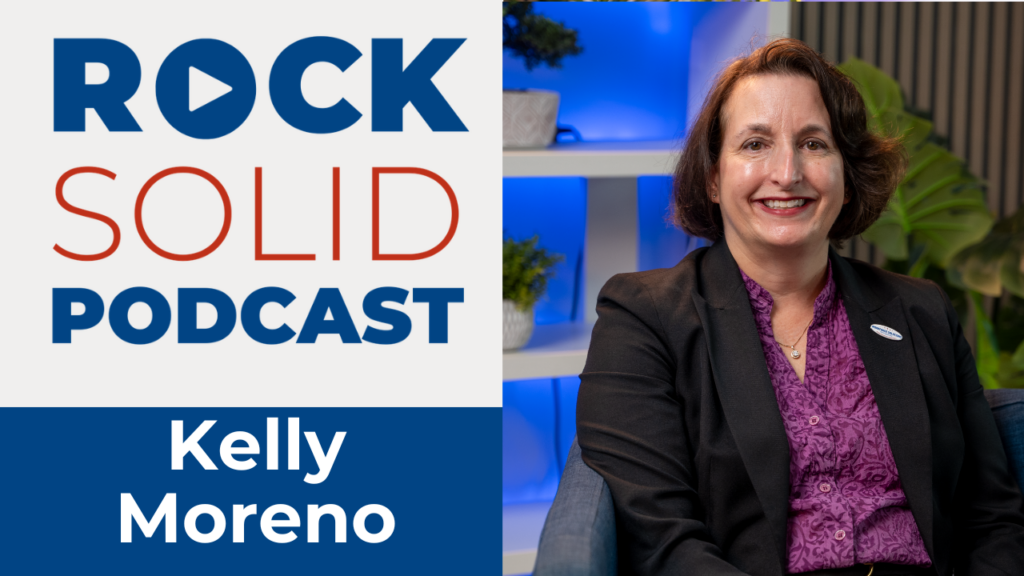
Most Round Rock employers don’t know she exists. Kelly Moreno would like to change that. As Chief Solutions Officer at Workforce Solutions Rural Capital Area, she runs a government-funded organization that will help you hire, train, upskill, write your retention strategy, and connect you with grants to pay for it all, at zero cost to your business. Nobody calls it a household name. The acronym WSRCA doesn’t exactly roll off the tongue. They even call themselves “Rural Cap” because it’s easier. But what they do for businesses in this nine-county region of central Texas is remarkable, and most of the people who could use it the most have never walked through the door.
Kelly came to WSRCA in 2022 after a career in Fortune 100 and 500 marketing, bringing an unusual combination: corporate branding instincts, a Master’s in Business Administration, and a genuine passion for connecting people to opportunity. She was WSRCA’s first Director of Community Engagement. In 2023, she was promoted to Chief Solutions Officer, the first such role in the organization’s history and the first of its kind among all 28 workforce boards across Texas. She’s been in Round Rock for 24 years, sits on the executive committee of the Round Rock Chamber, and spends her days making sure the employers and job seekers in this community aren’t talking past each other.
The moment that stopped Bryan cold: Kelly’s description of what’s happening to central Texas manufacturing. Samsung came. Tesla came. More are coming. And our region, which was never built for manufacturing, suddenly needed maintenance technicians it didn’t have. When a production line goes down, that’s thousands of dollars a minute. So WSRCA built an apprenticeship model with Texas State Technical College, where workers are employed by their companies and training at the same time. The first cohort is almost done. “We already have the curriculum,” Kelly said. “Let’s spread it out across all of it.” That is not a government agency waiting for things to happen. That is a team moving at business speed.
For Round Rock business owners, the practical message is this: there are free resources available to you right now. Free upskill grants, free internship matching, free business consulting on retention, free vocational rehab placements where even the salary for internship is covered. And one piece of advice that could save you months of wasted recruiting time: look at your job descriptions and ask whether you actually need that degree requirement. Kelly says most employers have never questioned it. The requirement was there when they inherited the job description, so it stayed. Meanwhile, the right candidate never applied.
What’s one requirement in your current job postings that you’ve never actually stopped to justify?
Key Takeaways From This Episode
- Workforce Solutions is not the unemployment office: The single most common misconception Kelly encounters. Unemployment is handled by the Texas Workforce Commission. WSRCA handles employer talent, upskilling, and job seeker matching. If you’ve avoided calling because you assumed they were the same thing, now you know.
- There is free money to train your employees: Texas employers can apply for Skills Development Fund grants through TWWC. A Round Rock semiconductor company recently received $145,000 to upskill 66 employees. WSRCA will help you write the application. If you’re not using this, you’re leaving real money on the table.
- Your job description might be the problem: Kelly’s direct advice: look at every role and ask whether you actually need the degree requirement listed. Many job descriptions are inherited and never revisited. Running them through AI to match required skills to actual job duties is a fast first step.
- Manufacturing in central Texas is not what you think it is: Samsung, Tesla, and companies following them are changing Round Rock’s job market. Modern manufacturing means clean rooms and career pathways from production technician to lead engineer, not the hot steel and unsafe conditions most parents still picture.
- You can get a free intern, and it may cost you nothing: TWC covers half the salary for college interns through their internship program. For Vocational Rehabilitation workers, WSRCA can place someone in your office and cover 100% of the cost, including all accommodations. One call to WSRCA starts the process.
Look at your job descriptions. Do you really need that bachelor’s degree? Are the skills you’re requiring matching what the job actually is?
Kelly Moreno, Chief Solutions Officer, Workforce Solutions Rural Capital Area
If you go into an electrical or plumbing apprenticeship, five years and you’re over six figures with no debt. And you can have your own firm — then the sky’s the limit.
Kelly Moreno, Chief Solutions Officer, Workforce Solutions Rural Capital Area
Every Gen Zer I’ve worked with is a rock star. They’re willing to change, they’re going to question — and we as leaders need to be willing to listen to that.
Kelly Moreno, Chief Solutions Officer, Workforce Solutions Rural Capital Area
Episode Chapters
- [0:00] Welcome to Rock Solid — Bryan introduces Kelly Moreno and gets straight to the question everyone asks: where did that name come from?
- [0:33] How “Roll Cap” Got Its Name — WSRCA covers nine counties surrounding Travis County, formed when they split away 40 years ago so growth funding would not all go to Austin. The acronym does not flow, so they just call it Roll Cap.
- [1:23] Round Rock Chamber and WSRCA — Kelly explains how her dual role on the chamber’s executive committee feeds intel back into workforce planning: what employers are hearing in the field, and how collaboration across counties creates a stronger region.
- [2:13] Samsung, Tesla, and the Manufacturing Shift — Central Texas was not built for manufacturing. Then the big names came. Now the region needs maintenance technicians urgently, and WSRCA built an apprenticeship with TSTC to create them.
- [3:46] Career Booklets for Middle Schoolers — WSRCA and the chamber built industry booklets covering the five target sectors, giving students and parents data on what jobs pay, what training is needed, and what the career path looks like.
- [4:32] The Biggest Employer Challenge — Businesses can’t wait two years for a trained engineer. Kelly explains how shorter training pathways get people on the floor now, while longer career ladders keep them growing.
- [6:26] Trades Pay — But Nobody Told the Parents — A plumber or electrician can hit six figures in five years with zero debt. Kelly says parents are the real career influencers for their kids, and most are still working off a “college or bust” script from decades ago.
- [7:41] What Makes Round Rock’s Collaboration Different — WSRCA presented their regional collaboration model at a national workforce conference. Most communities protect their turf. Here, partners set ego aside and ask who does this better and how they can build around that.
- [9:18] The Middle Skills Gap and Hands-On Certifications — Robots can’t do everything yet. Certifications in skilled trades and technical work represent the most durable career foundation right now, and universities are starting to add them to degree programs.
- [11:20] The Teacher Externship Program — A program running since around 2014 (Round Rock ISD was among the first) that lets career and technical education teachers shadow businesses, so they can teach from real-world experience, not theory.
- [12:32] Free Internships and Vocational Rehab Placements — The Texas Workforce Commission covers half of a college intern’s salary. Vocational Rehabilitation placements can be fully covered, including all accommodations, at zero cost to the employer.
- [14:33] $145,000 in Upskill Grants: What WSRCA Can Do for You — A Round Rock semiconductor company recently got $145K in Skills Development Fund money to upskill 66 employees. WSRCA helps you write the grant application. Most employers don’t know this exists.
- [17:32] Look at Your Job Descriptions — Kelly’s most direct employer advice: audit every role for requirements that don’t actually match the job. Run it through AI, or call WSRCA’s free business consultants. The degree requirement nobody questioned might be your biggest hiring problem.
- [20:40] Tools for Job Seekers: SkillFinder and Texas Reality Check — SkillFinder helps you identify natural aptitudes. Texas Reality Check shows you what life actually costs in Austin, then maps that to salary, career, and education. Both free, both available through WSRCA.
Frequently Asked Questions
What does Workforce Solutions Rural Capital Area actually do?
WSRCA is a nonprofit government-funded organization that connects employers and job seekers across nine counties in central Texas (Bastrop, Blanco, Burnet, Caldwell, Fayette, Hays, Lee, Llano, and Williamson). For employers, they help recruit employees, upskill existing staff, access training grants, set up internships, and work through retention challenges, all at no cost. For job seekers, they provide career coaches, training resources, and employment services. They are not the unemployment office, which is a separate function of the Texas Workforce Commission. Learn more at workforcesolutionsrca.com.
How can Round Rock businesses access free hiring and training help through WSRCA?
Contact WSRCA directly through workforcesolutionsrca.com or visit their Williamson County office. A business consultant will meet with you, listen to your challenges, and connect you with available resources: talent sourcing, grant applications for upskilling your current workforce, internship program matching, and retention consulting. Kelly recommends designating one internal champion to work with WSRCA, as companies that do this get the best outcomes.
What is the Skills Development Fund and how do Round Rock employers apply?
The Skills Development Fund is a Texas Workforce Commission grant program that pays for employers to upskill their current employees. A Round Rock semiconductor company recently received $145,000 to train 66 workers. Grants are available across many industries, including manufacturing, healthcare, and technology. WSRCA helps employers identify whether they qualify and assists with the grant application process at no charge. Contact WSRCA to start the conversation.
What is the Teacher Externship Program and how does my business get involved?
The Teacher Externship Program pairs career and technical education (CTE) teachers and school counselors with local businesses for real-world shadowing experiences. Round Rock ISD was one of the first districts to participate, starting around 2014. Teachers identify what they want to learn, WSRCA and the Round Rock Chamber (contact Zach Scott) make the match, and WSRCA handles the grant paperwork and funding. For businesses, it’s a direct way to shape what students learn before they enter your industry.
Can I hire someone through Vocational Rehabilitation without any cost to my business?
Yes. Through Texas Workforce Commission’s Vocational Rehabilitation (VR) program, WSRCA can place candidates with disabilities into internships or employment at zero cost to the employer. VR covers the full placement cost and all accommodations, including equipment, ramps, modified workstations, or anything else required. This opens access to a large pool of motivated job seekers that many employers never consider. Contact WSRCA to learn more about how to get started.
About Kelly Moreno
Kelly Moreno, MBA is the Chief Solutions Officer at Workforce Solutions Rural Capital Area, the first person to hold the title anywhere in WSRCA’s history and the first CSO among all 28 workforce development boards in Texas. She joined WSRCA in 2021 after a career in Fortune 100 and 500 corporate marketing, and has led the organization’s K-12 career coaching program, industry partnerships, and employer services. Kelly has lived in Round Rock for 24 years, serves on the Round Rock Chamber executive committee, and was recognized with the CTAT/ACTE Impact Award for Business-Education Partnership. She holds an MBA from the University of Houston Clear Lake and a BS in Marketing from Oklahoma State University.
Connect: LinkedIn | workforcesolutionsrca.com
More From Rock Solid
If this episode resonated, hear Kim Pollok on building a career through workforce relationships and saying yes before you’re ready and Anita Steenson on SBA resources most Round Rock business owners never tap — both episodes are about the free and low-cost infrastructure that exists to support businesses here, and how few people take advantage of it. Browse all Rock Solid episodes.
Watch or Listen
Prefer audio? Listen on your favorite podcast platform:
Full Episode Transcript
Click to read the full transcript
Bryan: Welcome to Rock Solid, the Round Rock Business Leaders podcast. Join your host, Brian Eisenberg, as he explores the journeys of entrepreneurs and companies across Round Rock, Texas. From startups and nonprofits to large organizations, each guest shares their passion for doing business in this thriving community. Let’s dive in.
Bryan: Hi everybody, it’s Brian Eisenberg and welcome to Rock Solid. This week I am joined by Kelly Moreno from Workforce Solutions Rural Capital Area.
Kelly: Correct.
Bryan: How’d they come up with that name? First of all, as a marketing person, how’d they come up with that name?
Kelly: I was part of that. No. What happened is we used to be just one big workforce center which included Travis County. And about almost 40 years ago now, we split with them and spread out so that all the money wasn’t being sucked up by Travis County as the nine counties grow. So we have the nine counties surrounding Travis. That’s how we became Rural Capital.
Bryan: Fair. Now at least I understand the thinking behind it. It is a mouthful.
Kelly: It’s a mouthful and the acronym does not flow. I am very much aware of that. But we just call ourselves Roll Cap and that works.
Bryan: So I know you because we both sit on the executive committee for the Round Rock Chamber. I’m mostly curious, because you do work with a lot of different counties, how does your role contributing to the Round Rock Chamber affect what you do day-to-day at Workforce Solutions?
Kelly: With Williamson County being our largest of the nine counties, Wilco tends to lead the way. Not that we don’t have a ton of growth going across all of central Texas, which is an exciting time to be here. What I get to hear from our communities out is what’s going on, and I can take that back to the chamber and say I’m hearing X, Y, or Z is happening in these counties. How can we get in that same sandbox and work together to build this community larger? Because as that corridor is developing all the way to San Antonio, we are going to be the new metroplex. It’s coming whether we like it or not. So it behooves us all to get together and work together to upsize everybody.
Bryan: What’s an example of a situation where you’ve brought everybody together to do something like that?
Kelly: One of the things we’re hearing from our employers is that as we’re going more into manufacturing, which is not typical in this region, more manufacturers are coming in thanks to Samsung and Tesla. We got a lot of attention and we needed to shift on how we handle that, because our school systems and community colleges weren’t built for it. One thing employers told us was: we don’t have maintenance techs to maintain our machines. When their lines go down, that’s a lot of money. So we created an apprenticeship model with the partners at Texas State Technical College and we’re graduating our first cohort in a couple of months. These individuals are already employed by their employers and going through the training to become the maintenance techs to keep these lines working. We’re also working with TSTC to bring that out to the new Bronos campus so it spreads out across the entire corridor. We already have the curriculum. Let’s spread it out.
Bryan: You’re wearing multiple hats because you’re the Chief Solutions Officer, which I love that title, and you head up the workforce talent council.
Kelly: Yes. Working with Zach on the chamber, we are developing programming to work in our middle schools to educate them on different careers. We’ve created a whole series of booklets on the five top industries we’ve targeted in this region. These are tools that students and parents can research to see what a job pays in three years, how you get the training, and what it requires. It gives them education to make a better decision on what they’re going to do after high school, because we know 60% of our graduating seniors do not have a four-year plan. And four-year plan does not mean college. It just means: what are you going to do in June?
Bryan: What’s the biggest challenge you see today? When I was working with Google, a client used to say working at Google was like working on quicksand, like everything was shifting under your feet. That feels like maybe worse than quicksand in the work environment today with AI and everything changing. What’s the big concern on both the employer side and the future employee side?
Kelly: For the employer side, it’s getting the talent they need right now. Business works at the speed of light. We can’t wait two years for an engineer. We have to figure out shorter training programs so people can get on the floor right then, and then build pathways as they grow. From the job seeker side, I think it’s lack of knowledge of what’s available. Our industries are changing here in central Texas and a lot of us growing up here never thought of manufacturing. Are they pulling hot steel down a line and we’re all going to burn? But it’s completely different now. You’re in a clean room, a safe environment, and the opportunities go from production tech all the way up to lead engineer. So educating the parents, because parents are the first influencers our kids have. And if you go into an electrical or plumbing apprenticeship, five years and you’re over six figures with no debt. And you can have your own firm, and then the sky’s the limit. We want to teach people that these opportunities are wonderful. There’s no stigma about being X, Y, or Z. I know I want my HVAC to work every summer.
Bryan: What kind of challenges do you see in communities that don’t collaborate as well?
Kelly: We actually had the opportunity to present last week at a national convention for workforce, showing how our groups can work together across different board levels and different counties. What I see is people wanting to hold on to their stakeholders. This is our mission and you can’t come across. I’m like, well, maybe we do this better than you, or you do that better than I do. So take that and let’s build around it and make this work together. It’s being open to those conversations and being willing to put your ego outside the door.
Bryan: You come from a corporate marketing background where I’m sure you’ve dealt with big egos. What I’m mostly curious about is: you know, my daughter is well into her career, my middle one is about to become a store manager, my youngest is still in high school trying to figure out what he wants to do, and the earth is shifting under him literally day by day. If you’re a parent today, from a learning perspective, what things are you saying are never going to go out of style?
Kelly: In Texas we have a middle skills gap, which is mostly trades and production line. If you can do something with your hands, most of the time there’s not something a robot can do. There are some things robots can do, but there’s a lot robots can’t do yet. So we always push: learn how to do something. Get a certificate program. If you want your engineering degree, fine, but get a certification in something as well. And we’re starting to see universities adding those certifications because they realize engineers needed to solder something but had never been taught. So those are being added in. And our high schools have a ton of certifications going through. Dual credit is also something I pushed for with my own kids. Instead of having to pass an AP test with a three or above, I knew I’d guarantee a school credit with dual credit work.
Bryan: I want to come back to that title Chief Solutions Officer. You’ve rolled out some great solutions, including the teacher externship program. Tell us about that and how business owners listening could take advantage of it.
Kelly: This program has been going for a long time. Round Rock ISD was one of the first, around 2014. It’s an opportunity for teachers to go in and shadow businesses in the areas they’re teaching. We try to focus on CTE teachers and counselors so they can provide better guidance. Teachers tell us what they want to see, we work with the chamber’s Zach Scott who makes the connection, and we handle the grant paperwork and funding. Any business that’s interested: get with Zach Scott at the chamber and he can help set it up.
Bryan: And there are other internships available for companies?
Kelly: Yes, through the Texas Workforce Commission. They have a program where, for college students specifically, TWWC will pay half the salary. It can be a summer intern or any time of year, with a minimum of about three months. Then there’s also Vocational Rehabilitation, which is a section of TWWC for individuals with disabilities. They will provide the internships and pay for everything, including all accommodations. I’m actually getting ready to start interviewing for one for our own marketing department. For a business like Bill’s who runs social media services, if he wanted to train someone, he would contact us, we connect him to the right person, and we watch the process and help with any paperwork.
Bryan: For the Vocational Rehab placements, if someone needs a ramp or special equipment?
Kelly: They cover it all. That’s even if you hire someone permanently afterward. TWWC covers all of that. Computer screens, anything special, they’ll take care of it for you.
Bryan: What’s the one thing you see day-to-day that most people get wrong and keep doing?
Kelly: Most people think Workforce Solutions is the unemployment office. We are completely separate. Unemployment is handled solely at TWWC. We handle bringing in employees for employers, helping them find talent, and upskilling their current employees. Our first customer is the employer. Texas is different than a lot of other states in how they run workforce, in that we put employers first because they drive the demand. I can’t tell an employer I’ve got X when they need Y. We listen to our employers and match accordingly. And if they need to upskill current staff, we have funds available through TWWC to do that and we’ll help write the grants.
Bryan: Can you give an example of someone who came to you to upskill?
Kelly: We just had one here in Round Rock. I can’t say their name, but it’s in the semiconductor field, which is a governor’s priority. We did a Skills Development Fund and raised $145,000 to upskill 66 employees. That’s very meaningful for them and the staff appreciates it too, because they know the company values them. Retention numbers go up when that happens. And if you’re an employer struggling with retention, let us come work with you. We have business consultants who will sit down with you, do a strategic plan, and figure out what’s going on at no cost.
Bryan: My wife and I own a home care agency, which traditionally has a horrible turnover rate, around 80%. Would you sit with us and help figure out retention?
Kelly: Absolutely. We’d sit down and say, this is what we’ve seen in similar industries. Maybe it’s an extra day off, whatever little tweaks make sense. And this is all at no cost to the employer. All they have to do is get in touch with us.
Bryan: If there’s one thing you could tell employers about being prepared for what’s coming in the workforce, what would it be?
Kelly: Look at your job descriptions. Do you really need that bachelor’s degree? What are the skill sets you’re requiring and what is the job? Are they matching up? If they’re not, let’s see why. Is it just inherited? We all get a little behind and can’t go rewrite a job description. Put it through ChatGPT or Claude and say this is the job they have to do, write me the skills. That’s one thing. Another is, if you’re interested in working with workforce, designate someone who is assigned just to work with workforce. Be our champion in the company. Companies that have been most successful getting money through TWWC are the ones that have a champion, and it’s usually an HR person, but it doesn’t have to be.
Bryan: If you had to put your corporate marketing hat on and market new positions rolling out in the next 10 years, how would you position those?
Kelly: Write job descriptions for people who will be adaptable to new technology. And our Gen Zers, I have to say, do a fabulous job of that. I know they get a lot of bad press, but every one I’ve worked with is a rock star. They see so much potential and they are willing to change and willing to question things. As older adults in leadership roles, we need to be open to those suggestions. They’re the ones who are going to move companies to the next level, or you’re going to be left behind.
Bryan: For employees either getting ready to jump into or already in the workforce, what do you want them to take away about what job security looks like for the future?
Kelly: People are jumping jobs quite frequently now, and that’s expensive for companies. Retraining costs around $30,000 even at the entry level. For employees: find out what you want to do. We have resources like SkillFinder that let you take a test and see where your natural inclinations are. We also have Texas Reality Check, which lets you figure out how much life actually costs. You put in I want to live in Austin in a three-bedroom house, and it breaks down your internet, your phone, everything. It shows how much you need to make, what careers make that, and what education you need to get there. I was in a school once and a student had this dream life that required $180,000 in salary. It was an eye-opener. You need to be an MD and here’s what that college education costs. Students need to take the time to look at that. And when I connect resources and make that match, that makes my day. So find your natural skill sets, what makes you happy, and keep trying new things.
Bryan: What are your favorite resources here in Round Rock?
Kelly: I’ve been here 24 years. Resources wise, I love going downtown and walking around, checking out our library system. Our library is fantastic. And of course Dell Diamond, Kalahari, they’re always fun. But being able to be out in the community here and how everyone comes together to help, that’s what I love most. Mayor Morgan and the council do a great job of focusing on livable areas. The green spaces are where I enjoy most. And the parent involvement in our ISD is fantastic.
Bryan: Thank you so much for your time today. Really appreciate you educating both future employees and employers on what they can do in the community.
Kelly: Please reach out to us, because we’re here to help.