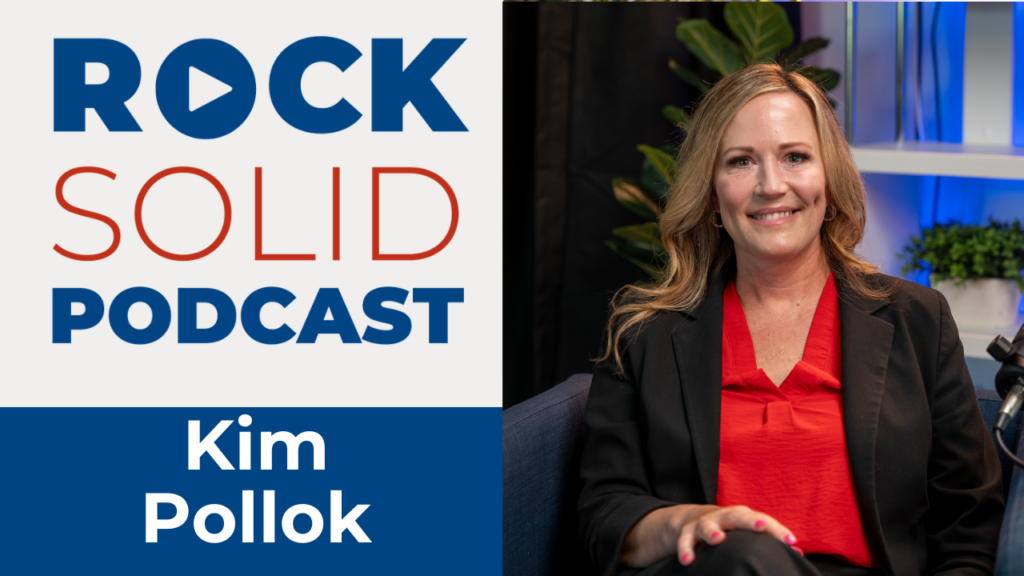
Kim Pollok’s company gave everyone notice on December 31st. Two thousand people out of work, and Kim was the HR manager standing between them and the exit. She didn’t leave first. She helped every single one of them find somewhere to go.
That afternoon, after the doors closed for the last time, SWBC called. They had a benefits coordinator position. Entry level. Ten thousand dollars less than she was making. She had two young kids, no college degree, and no better certainty than that one phone call. She took it the same day. That was 2010. Today she runs the company.
That is not a story about luck. It’s a story about saying yes when you have no idea what you’re walking into, about building trust one act of service at a time, and about what happens when you show up for other people before you worry about yourself. When Bryan sat down with Kim Pollok, CEO of SWBC Payroll + HR, for this episode of Rock Solid, the conversation kept circling back to one theme: relationships are the infrastructure everything else is built on.
For Round Rock business owners, that is not a soft idea. SWBC serves companies from 5 employees to 7,000, across 42 states, in industries from urgent care to pig farming. Their retention rate is high. Their clients become friends. And the reason, Kim will tell you plainly, is that they are not a transactional company. They are built on people knowing people, on CEOs who show up at chamber events and actually talk to you. Round Rock found Kim that way. Brad Napp invited her to lunch and told her about the community. She felt welcomed. SWBC has been sponsoring events here ever since.
What would happen in your business if every decision you made started from the question: how do I show up for the people in front of me right now?
Key Takeaways From This Episode
- Say yes before you’re ready: Kim’s path from entry-level coordinator to CEO came from volunteering for things she didn’t know how to do, then figuring them out. The PEO acquisition landed in her lap because she kept saying yes to projects nobody else wanted. Readiness is a myth. Willingness is the actual requirement.
- Stop collecting dead birds: Kim’s mentor Susan Stewart taught her this: don’t let people drop their problems on you without bringing solutions too. As you move up, people will constantly present you with dead birds — problems you can’t do anything with. The leaders who last are the ones who train their teams to bring solutions alongside the problem.
- Ask for the mentor, even if you’re scared: Kim cold-asked two of the highest people in her company to mentor her. She’d never spoken to either of them. She came prepared with a binder of questions. None of that worked. What worked was showing up, building rapport, and trusting the relationship to develop. Fifteen minutes of courage changed the trajectory of her career.
- Different generations need different things: For Round Rock small business owners managing teams across generations, Kim’s message is practical: consistency in standards, flexibility in motivation. A baby boomer who lives to work and a Gen Z employee who works to live are both doing their jobs right. Your job is to understand what drives each one.
- Relationships are the one thing AI cannot replace: SWBC uses AI cautiously and with strong security guardrails. But Kim is clear-eyed about what it can’t do. You’re not going to build a real relationship through a chatbot. In a business like SWBC’s, where clients become friends and trust is earned across years of showing up, that’s the whole game.
Saying yes almost every time, even when I had no idea what I was doing. That’s what led to the different promotions.
Kim Pollok, CEO, SWBC Payroll + HR
You don’t allow people to just give you their problem without some solutions, because you’re collecting everyone’s dead birds and you can’t do anything with it.
Kim Pollok, CEO, SWBC Payroll + HR
You’re not going to build a relationship with AI. Our business is built on relationships, not transactional. That will never change.
Kim Pollok, CEO, SWBC Payroll + HR
Episode Chapters
- [0:00] Welcome to Rock Solid — Bryan introduces Kim Pollok, CEO of SWBC Payroll + HR, and sets up a conversation about what it really takes to build a business on relationships.
- [0:32] Why Women Who Mean Business — Kim explains why SWBC sponsored the event: supporting women, elevating the community, and what she walked away thinking about.
- [1:35] The Real Value of Events — Networking versus speakers: why Kim says it was both, and what stood out about Cat Osterman’s panel on following your passion.
- [3:19] The Career She Never Planned — Kim wanted to be a neuropsychologist. Instead she stumbled into HR at a young age, spent 12 years at a 2,000-person contact center, and didn’t see what was coming next.
- [4:22] The Day 2,000 People Lost Their Jobs — The company closed on December 31st. Kim spent her last weeks helping every employee find a new home. That afternoon, SWBC called with an entry-level offer $10K below her salary. She took it without hesitating.
- [5:17] Saying Yes in the Dark — The mindset that carried Kim from benefits coordinator to CEO: volunteer before you’re ready, research what nobody else will, fake it till you figure it out for real.
- [7:09] Finding Your Mentors — Kim cold-asked two of SWBC’s most senior executives to mentor her. She barely knew them. She showed up with a binder. None of that mattered as much as just asking.
- [9:33] Dead Birds — The leadership lesson from Susan Stewart that Kim now teaches her own team: when someone brings you a problem, they need to bring a solution too. Stop collecting dead birds.
- [11:31] Five Generations, One Team — Baby boomers, Gen Z, and everyone in between: why managing them identically is the wrong call, and how Kim thinks about motivation, retention, and fairness across the spectrum.
- [15:11] The Water Cooler Is Back — What happened when SWBC brought employees back to the office after years of remote work, and why Kim says you just cannot replicate that energy online.
- [15:34] AI in HR: Careful, Not Afraid — How SWBC uses a private AI instance for research and drafting, why their security team keeps sensitive data out of it entirely, and what Kim thinks every employer should understand about the risk.
- [18:09] What Never Changes — Bryan asks: in all this chaos, what stays the same? Kim’s answer is one word. People. And everything that follows from that.
- [22:13] Why Round Rock — Brad Napp invited Kim to lunch and made her feel welcome. Now SWBC sponsors events here regularly. Kim says Round Rock has something most communities don’t: genuine warmth and constant activity.
Frequently Asked Questions
What does SWBC Payroll + HR actually do for small businesses?
SWBC Payroll + HR is a professional employer organization (PEO) that functions as the outsourced back office for small and mid-size businesses. They handle payroll processing, HR management, benefits administration, compliance, background checks, safety programs, and more. The model gives business owners access to over 70 specialists at a fraction of the cost of a full in-house team, so they can get back to doing whatever they actually got into business to do. They serve companies with as few as 5 employees and as many as 7,000, across 42 states. Learn more at swbcpeo.com.
How did Kim Pollok become CEO of SWBC Payroll + HR?
Kim joined SWBC in 2010 as an entry-level benefits coordinator after her previous employer — a 2,000-person contact center — closed its doors on December 31st. She took the role the same day SWBC called, accepting a $10K pay cut with two young kids at home and no college degree. From there, she advanced by consistently saying yes to projects she didn’t know how to do, leading SWBC’s PEO division acquisition in 2011, and building mentor relationships with senior leaders in the company. She was promoted from Director of Operations to CEO.
What is the “dead birds” leadership lesson Kim Pollok shares in this episode?
Kim’s mentor Susan Stewart, SWBC CEO of their mortgage division, taught her to stop letting people drop problems on her without solutions. The metaphor: when someone hands you a dead bird, you can’t do anything with it. As a leader, if you let your team bring you only problems, you end up carrying everyone’s dead birds and can’t function. Kim now teaches her own team the same thing: bring me a problem, but bring a solution alongside it. It’s a lesson about developing problem-solvers, not just problem-reporters.
How should small business owners in Round Rock think about AI in HR?
Kim Pollok’s take is clear: don’t ignore it, but don’t rush it. SWBC uses a private AI instance for research and email drafting, with strict security controls to keep any client or employee data out of it entirely. Kim’s concern isn’t AI’s usefulness — she sees real value in it — but the data security risk, especially for businesses that handle sensitive employee and financial information. Her advice for small business owners: start small, keep sensitive data out of it, and get guidance from your IT or HR professionals before embedding it into core systems.
How do you ask someone to be your mentor when you’ve never met them?
Kim did exactly this with Susan Stewart and Mark Hein, two of the most senior executives at SWBC, when she had barely spoken to either of them. Her advice: just ask. Find people who are living the values you want to build, who have real stories of struggle behind their success, and take a chance. She came to that first meeting with a binder full of questions. None of it mattered as much as showing up, being genuine, and building rapport over time. Both mentors still guide her today.
About Kim Pollok
Kim Pollok is the CEO of SWBC Payroll + HR, a professional employer organization serving businesses across 42 states. She joined SWBC in 2010 as an entry-level HR consultant the same day her previous employer closed its doors, then built her way to CEO by saying yes to every opportunity, including the ones she had no idea how to handle. She founded Women Supporting Women in Texas Business (WSW TX) and is active with NAPEO, EO Austin, and the Round Rock Chamber.
Connect: LinkedIn | swbcpeo.com
More From Rock Solid
If this episode resonated, hear Selicia Sanchez-Adame on building bold businesses and owning your voice and Anita Steenson on resilience and what small business owners need to know — both guests understand what it means to build something real in a community that shows up for you. Browse all Rock Solid episodes.
Watch or Listen
Prefer audio? Listen on your favorite podcast platform.
Full Episode Transcript
Click to read the full transcript
Bryan: Welcome to Rock Solid, the Round Rock Business Leaders podcast. Join your host, Brian Eisenberg, as he explores the journeys of entrepreneurs and companies across Round Rock, Texas. From startups and nonprofits to large organizations, each guest shares their passion for doing business in this thriving community. Let’s dive in.
Bryan: Hi everybody, it’s Brian Eisenberg and welcome to Rock Solid. I’m here today with Kim Pollok from SWBC payroll and HR. Welcome.
Kim: Thank you. I’m happy to be here.
Bryan: I got to see you this past week because you decided to sponsor the Women Who Mean Business event. I want to dive into that because I’m curious — what made you decide that was the event you needed to sponsor?
Kim: Just the women in general. We really want to support women. I heard about the great speakers that were going to be there, how large the event has grown over the years. This is my first time attending and I just wanted to be able to put that money toward — let’s make this, let’s elevate this event — and it was great. The whole day was great, the turnout was great. And then just being able to support the Round Rock Chamber. I enjoy doing that. It’s a great chamber.
Bryan: When you talk about a great event, because a lot of people struggle when they think about events — obviously you’ve got the content and the networking — to you, what’s the most valuable part of events like that?
Kim: I would say one of it is the networking part. They gave a lot of opportunities for me to work the room, speak to people I’ve seen, but also there were a lot of people I had no idea who they were. A lot of new faces. It wasn’t your typical chamber event and it was magnificent to see that.
Bryan: That was so nice. I met so many new people. But I also think just listening to the speakers — the panel they had up there was just amazing.
Kim: Yes, and I think those two things were my biggest takeaways.
Bryan: Now, you’ve been the CEO for a while. What was the biggest takeaway for the people who didn’t make it out there? One of the reasons Bill, Brent, and I decided to start this podcast is because not everybody gets out to all these events. They don’t get to connect with amazing people in our community. So we wanted to bring the community out to them. What was one of those things you said, “I wish everybody would have heard this”?
Kim: That panel. Listening to Cat out there — I love softball, I played softball, and she was one of the panelists. Listening to her journey and where she is today, and all of the panelists on there. That panel was just inspiring.
Bryan: Yeah. To me the big takeaway from Cat was her decision to follow her passion and not just take the standard advice of getting that nine-to-five job. Which is interesting because here you are helping people with their nine-to-five job and payroll and all of that. And your passion wasn’t in HR, but you kind of stumbled into it.
Kim: That’s exactly right. Yeah. I wanted to be back in the day a neuropsychologist. That sounded really cool until I realized how many years I would have to go to school. But yes, I did stumble into HR at a very young age and ended up in operations after a 12-year run with my old company, and ended up at SWBC. Here we are today.
Bryan: And from what I understand about your story, you really started at SWBC trying to help other people get jobs because the business was closing.
Kim: Yes. So I was with my former company for about 13 years. I was the HR manager at that time. They had over 2,000 employees. It was a call center and they came in and said we’re going to lay everyone off unless you want to move to El Paso. That was not happening for many of the employees. So we brought in SWBC as one of the companies that could do a job fair and help these employees find work. I talked to them, and we closed our doors on December 31st. That afternoon SWBC called and said we have a benefits coordinator job. It’s very entry level. It’s $10,000 less than what you’re making now. I didn’t even think — I just took it. I had two little ones at the time and no college degree either. I just took it and I had no idea what I was doing. But I learned quickly and started taking on more projects and tasks, and that’s when the PEO acquisition came up.
Bryan: And how did you go from this entry-level position to becoming CEO? What were the things behind the scenes that helped you make that journey?
Kim: Saying yes almost every time, even when I had no idea what I was doing. Volunteering for projects, volunteering to learn and research. Back then we didn’t have ChatGPT. When the acquisition of the PEO came up, the owners of SWBC — it’s privately held, Charlie Motto and Gary Dudley — they said we want to buy a PEO and no one really knew what that was. So I researched it. There was a PEO where the owners were retiring, and my former CEO said let’s go in and figure this all out. It took a lot of research. It was truly fake it till you make it. We really did try to figure out what we were doing in real time. But I just kept saying yes. Taking on challenges I had no idea how to handle. And that’s what led to the different promotions.