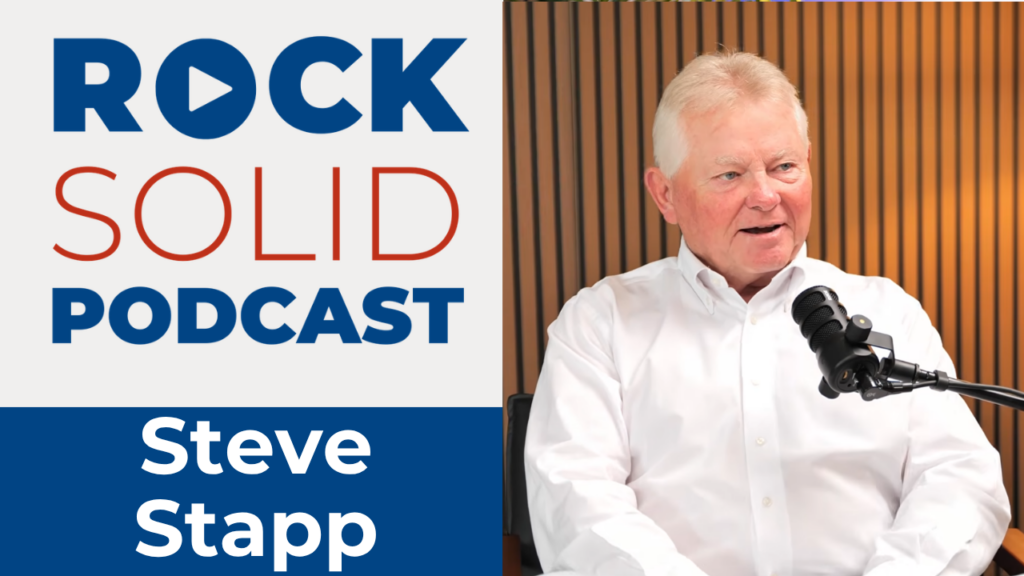
Steve Stapp’s answer to an upset customer was never a script. It was your money back, no cross-examination required. That single habit, repeated for decades, is most of the reason a bank that opened its doors in the middle of the 2008 financial collapse now holds more than a billion dollars in assets.
Steve Stapp started in banking in 1978 and moved to Round Rock in 1999. By 2008 he had spent nearly thirty years learning what actually holds a bank together, and when the bank he worked for sold, a group of local investors came to him with an idea that regulators kept trying to talk him out of. Every application he filed with the Federal Reserve, the FDIC, and the state came back with some version of the same question: are you sure you want to do this right now?
He was sure, because he had a philosophy that had nothing to do with market conditions. Do the right thing for the right reason in every situation. In practice that meant something specific: if a longtime customer got hit with a fee and pushed back, the fee came off the account before the argument started. Not because the customer was always right. Because a five minute refund was cheaper than losing a relationship that would put a mortgage, a business loan, and every deposit for the next thirty years through the same set of doors.
That decision built R Bank from twelve employees in one Round Rock office into roughly ten branches and about 170 bankers. It also explains something about why this community works the way it does. Williamson County rewards the businesses that show up on the boards, the chamber events, and the Little League sidelines, not just the ones that run the best ad. Stapp calls it competitive but kind, the kind of place where 99 percent of the people you ask for help will actually help you.
If your business tracked every decision by the relationship it protected instead of the revenue it collected this quarter, what would you stop doing tomorrow?
Key Takeaways From This Episode
- Refund the fee before you defend it: A one-off complaint from a good customer is not a policy violation, it is a chance to prove the relationship is worth more than the transaction. Stapp’s rule was simple: give it back first, review the pattern later.
- Chaos is a green light, not a red one: R Bank filed its charter applications during the worst months of the 2008 financial crisis, while competing banks were playing defense on their own bad loans. Being the one clean, aggressive lender in a frozen market is how you end up with ten branches and a billion dollars in assets.
- Saying no is the hardest and most valuable service you offer: Stapp says his bankers spend more time explaining why a loan cannot be approved than they do approving one, because lending someone money they cannot repay is not help, it is harm with better paperwork.
- Show up where nothing is being sold: Trust is not a tagline. It is sitting on the YMCA board, the hospital board, and the chamber calendar year after year, long after you have stopped needing new customers.
- Round Rock’s real competitive advantage is that people actually help each other: Stapp estimates that 99 percent of the business leaders, city staff, and county officials he has ever asked for help have said yes.
We just talked about it all the time: do the right thing for the right reason in every situation.
Steve Stapp, Former President & CEO, R Bank
I don’t want to do transactions with you. I want to build a relationship with you. The transactions are not important.
Steve Stapp, Former President & CEO, R Bank
I’ve lived in four communities in my career, and this one is very, it is unique. I’m telling you, it is unique.
Steve Stapp, Former President & CEO, R Bank
Episode Chapters
- [00:00] Why Open a Bank in the Middle of a Financial Collapse: Stapp explains why 2008’s chaos was actually the right moment to launch.
- [02:32] From One Office to a Billion Dollars: how nine branches and a clean reputation outran competitors busy cleaning up bad loans.
- [04:23] The Philosophy Behind Every Decision: “do the right thing for the right reason,” and what it costs the bank short term.
- [05:52] Give the Fee Back Before They Ask: the customer service rule that built three decades of loyalty.
- [09:56] What “Relationship Oriented” Actually Looks Like: Stapp’s test for telling real trust from a marketing slogan.
- [12:38] The Hardest Job in Banking: why turning someone down for a loan takes longer than approving one, and why that is the point.
- [16:23] How to Plug Into Williamson County: Stapp’s advice for entrepreneurs who feel like they are building alone.
- [23:00] Why He Retired in Round Rock: the real reason he never left after more than 25 years in the same community.
Frequently Asked Questions
Who founded R Bank in Round Rock, Texas?
R Bank opened in Round Rock in 2009 after a group of local investors recruited banking veteran Steve Stapp, whose previous bank had just been sold. Stapp served as President and CEO for 16 years before retiring, growing the bank from a single office into roughly ten branches with more than a billion dollars in assets.
Why did R Bank launch during the 2008 financial crisis?
Stapp says the timing actually worked in the bank’s favor. Competing banks were consumed with their own bad loans and had pulled back from lending, which left an open lane for a bank with a clean slate that kept making loans and building relationships while everyone else played defense.
What is R Bank’s customer service philosophy?
R Bank’s stated philosophy is “do the right thing for the right reason in every situation.” In practice, that meant empowering every employee to refund a customer’s fee on the spot rather than defend the charge, then review any repeat pattern after the fact.
How many branches does R Bank have in Texas?
As of this episode, R Bank operates roughly ten branches across Central Texas with about 170 bankers, after starting with twelve employees in a single Round Rock location in 2009.
Is Steve Stapp still involved with R Bank?
Stapp retired as President and CEO in 2024 after 16 years leading the bank and 47 years in banking overall. He remains active in the Round Rock community through the Chamber, the YMCA metro board, and the St. David’s Hospital board.
About Steve Stapp
Steve Stapp spent 47 years in banking before retiring as President and CEO of R Bank, the Round Rock bank he helped launch in 2009 in the middle of the worst financial crisis in a generation. Under his leadership, R Bank grew from twelve employees and one office into roughly ten branches and more than a billion dollars in assets, built on one rule: do the right thing for the right reason, every time. He has lived in Round Rock since 1999 and continues to serve on the Round Rock Chamber, the YMCA Metro board, and the St. David’s Hospital board.
More From Rock Solid
If this episode resonated, hear from Matt Kata, an R Bank commercial lender carrying the same relationship first playbook forward, and Kevin Koym, who says communities build businesses, not the other way around. Browse all Rock Solid Leaders.
Watch or Listen
Full Episode Transcript
Click to read the full transcript
Bryan: Hi everybody, it’s Bryan Eisenberg. Welcome to Rock Solid. I’m here today with Steve Stapp. Thank you so much for joining us.
Steve: Yes, sir. Thank you. I’m glad to be here.
Bryan: You have been a fixture in the Round Rock community for twenty some years. I want to start with a clarifying question, because I’m truly trying to understand this. We just finished a podcast with our last guest and we were talking about 2008, and that’s when you started the bank. I remember 2008 really well, because we had taken my company public and we all know what happened with the banks and the marketplace. The market was terrible, and you guys decided it was time to open up a bank. Was that audacious? Was that craziness, or did you have a different story in mind about why you needed to open a bank right then?
Steve: Yeah, it was the investor group that approached me about it. It was just the timing. The bank I was with had just sold, so I was doing some consulting work, and all the pieces kind of fell into place. It’s funny you say that, because when we were filing applications with the Federal Reserve, the FDIC, and the state, the first question every one of them asked was, “Are you sure you want to do this right now? Do you see what’s going on around you?” The world was kind of coming apart in that area. But I think the timing was actually really good, because so many of the other banks had lending problems, or other things going on that had tainted them in some way. Our slate was clean. Those other banks were struggling with their own problems, and they weren’t aggressively trying to attract new business or make loans. They weren’t doing the things we needed to be doing. Everybody was going right, and we were going left. We were kind of going upstream, if you will. And it worked out really well.
Bryan: You’ve got over a billion dollars in assets today. Was it nineteen branches for the bank?
Steve: I believe we’ve got nine now. We recently had one in Schwertner that wasn’t doing well, so they closed it.
Bryan: But still, a billion dollars in assets is not something small. I think there’s a great lesson there for any entrepreneur, because so many people hear that the market’s in terrible condition and hesitate to do anything. I believe that when there’s friction, when there’s chaos, there’s opportunity.
Steve: Right.
Bryan: And you guys found the opportunity. Lots of other people don’t want to press on the gas. They’re not looking at what opportunities are out there. You capitalized on it. Why do you think so many entrepreneurs struggle to understand that? When so many people are struggling, that’s when you really need to press on the gas.
Steve: A lot of times, when you’re an entrepreneur and there are other people in the community doing the same thing or something similar, you can’t help but watch what they’re doing. And if they’re struggling, and about everybody is struggling, you can’t help but have that thought in the back of your mind: is this going to work? We’ve got a good plan, we’re going to execute it, and I think it’s going to work fine, but these other people are smart too, and what they’re doing isn’t working. That creates doubt. But you just have to go. You put your plan together, you execute it, and you go with it. There’s a saying: he who hesitates is lost. That’s kind of what that is. If you get ready to go and then start taking little bitty steps and stop, it’s not going to work. It’s kind of like the concept of the mustard seed. Either you have faith or you don’t, it doesn’t matter if it’s tiny or massive, you either have it or you don’t. Same thing. If you have that little bit of hesitation, the market’s going to feel it. You’re going to feel it.
Bryan: There’s one other key, because you said have your plan and execute it, but the other one is about building trust with your customers. You had a core line that explained your philosophy and how you ran things. Can you share what that core philosophy was?
Steve: We talked about it all the time: do the right thing for the right reason in every situation. If you charge somebody a fee and they come in upset about it, we would empower all of the employees and tell them, if someone comes in and they’re really upset and they don’t have a bad record with us, but they made a mistake and got charged the fee, I don’t want you to hesitate. Give them that fee back. Now, if they do it fifteen times, that’s a different situation, and we may need to get a group together to counsel with them about how they’re doing. But the one off things, when something needs to be changed or they’re unhappy about it, don’t hesitate to try to fix it for them. It may not be the right decision, but you do it, and we’re good. Then we’ll look at it after the fact, and if we determine it wasn’t a good decision, we’ll learn from it and do something different next time. But don’t hesitate to provide that service, because that’s how you build trust with people. And when people trust you, they’re going to stay with you and do business with you.
Bryan: There’s so much wisdom to unpack there. You probably made a lot of decisions in the short term that were right for the customer, because you valued trust over the transaction.
Steve: Yes. If you’re building a business, especially in banking, you want that to be a long term relationship. Almost every business should be thinking that way. And the relationship is built on that trust. You can’t hesitate. You have to be real about it, and consistent with it. Then they trust you, they build that relationship with you, and they’ll be with you forever.
Bryan: Why do so many business owners struggle to understand that concept? How many years have you been in banking?
Steve: Forty seven years.
Bryan: Forty seven years. I’m sure you’ve worked with thousands of business owners and entrepreneurs. Why do people struggle to understand that trust is so fundamental to everything they do? In banking, we often get focused on the numbers and the short term gains, and we neglect the long term. Where does that disconnect happen?
Steve: They get lost in the numbers. They’re going along, they charge a twenty five dollar fee to a customer, and they don’t want to give it back because it hurts the bottom line. But giving that twenty five dollars back has cemented the relationship with that customer. They’re going to be with you forever. They’re going to put their money with you, borrow money from you, and you’re going to make that money back over a thousand times over a long period of a relationship. Don’t worry about the one off situations where you give it back. You’re getting lost in minutia at that point. You have to look at the long term relationship. Short term decisions can hurt you or affect you, but you can go back, look at them, and evaluate them, and maybe change a policy going forward. It’s not just doing transactions with people. A lot of banks nowadays are striving to get people to do transactions with them. I don’t want to do transactions with you. I want to build a relationship with you. The transactions are not important.
Bryan: I want to dig into that, because I’m a bit of a word nerd. Everyone’s marketing relationships. Everybody says they’re doing it. How do I, as a business owner, really know the difference between someone saying they’re relationship oriented and what relationship oriented actually looks like?
Steve: It’s not only seeing them at the place of business, it’s seeing them out in public. They see you on boards, on committees, in the community doing things to help the community be better. They understand that you want things to be better, so we can do better. All of that is long term, as opposed to mailing out thousands of credit card applications. You never see that person, you never meet them, it’s all done through the mail or online. There’s no personal interaction. That’s not a relationship, that’s a transaction, and they can do that with anybody. But when you build a relationship with someone, you help them understand that you’ll do things for them nobody else will. You’ll be there. You’ll help them work through things. You want them to be successful so you can be successful. It’s not just how many deposits you made last week, it’s the overall relationship as a whole.
Bryan: Now that you’ve retired, how do you feel seeing whether that philosophy and that culture are continuing? What did you do to make sure that culture is the cornerstone of the bank?
Steve: The proof is in the pudding. We were very successful for seventeen years. If it’s working, why would you change it? Maybe somebody thinks they need a new marketing campaign to freshen up. I’ve seen strange things happen. Times change and economies change, but relationships with people don’t really change, and values shouldn’t change either. And one of the hardest things in banking is turning somebody down for a loan. They come in, they’ve got a plan, and you turn them down, but you turn them down for reasons you can document and that are transparent. The worst thing you could do is lend them the money anyway when the documentation says they can’t afford it. You’re not helping someone if you lend them money they can’t pay back. That’s the worst thing you can do. But it’s the hardest thing to tell them no. I always spent more time, and all of our folks tried to, letting people know why. You spend ten minutes when you call somebody and say, “Come in and sign it, we’re good to go.” But you spend an hour telling them why you couldn’t do it, and maybe how they could change their plan or try a different method. You spend more time turning people down than you do approving them.
Bryan: You’ve been in this community since 1999. You’ve seen a lot of change here in Round Rock. What are the things you see that haven’t changed?
Steve: The quality of the people who live here. When I first came here, I met Charlie Culpepper and Nyle and all the people running things at the time, and they’re consistently good quality people who genuinely care about each other and the community. You see that example after example. Charlie Culpepper’s daughter Christine came back here to live, and a bunch of the kids come back here because the quality of life is good, and they carry that on. Round Rock and Williamson County as a whole genuinely have good quality people who care about each other and the community. People who move here get involved, they see that, and they want to be part of it.
Bryan: What’s your biggest piece of advice to business owners in Williamson County who aren’t connecting with these people, who aren’t tapping into this community? We all know entrepreneurship can be lonely. How do you help them navigate and plug in?
Steve: The community is so open and so supportive, it would be a big mistake not to jump in. Let people help you. When someone starts a business and has a competitive side, they think, “I’m building widgets and he’s building widgets, I’ve got to beat him,” instead of getting to know him and learning from him. People in Williamson County are competitive, and they do things the right way, but they will help you if you ask. I guarantee you ninety nine percent of the business folks, the leadership, and the community here will help you. The city will help you. The county will help you. The mayor is an awesome guy. If you have a problem and you reach out, they’ll help you.
Bryan: There are a lot of banks opening up. How do they all make it work? How do they all support the community, and how do I, as a consumer, pick the right one for me?
Steve: It’s a very competitive business. When we started the bank in 2008, I believe there were nineteen banks in Williamson County. Now there’s probably over forty or fifty. The banking business has changed so much. So many banks leverage technology now and don’t have as many employees as they used to. If you’re going to do business with someone you don’t know personally, is that as important as with the person who has your money? Probably not. You need to go and meet those people. I started in banking in 1978, so it was a totally different deal than it is now. Technology is awesome, and it can do a lot of things, but it takes the personal touch out of so many things. If I were looking for a bank, I’d want to meet and greet the people there, sit down and talk to them, and see if I built a rapport with them and their leadership. I’d recommend coming to some chamber events. There are some incredible personal and commercial bankers throughout those events.
Bryan: What made you decide Round Rock was the community you needed to retire in, and what does it offer someone who’s retired?
Steve: You have all these relationships you don’t want to leave. Probably the biggest thing is we have three kids who live in the area, and they have kids, so we’re not going to move far away from those grandbabies. Why would you leave somewhere you’ve been for so long and enjoyed for so long, just because you don’t get up and go to work every day? The same people are there, you can go see them at different events that go on all the time. Why would you leave your family? That’s kind of how I feel about Williamson County and Round Rock, that’s my family, and I’m not leaving them.
Bryan: Where are people going to run into you in the community if they want to connect with you or grab a little bit of that wisdom?
Steve: I’m still involved in the chamber. I’m on the metro board for the YMCA. I’m on the St. David’s Hospital board. I spend quite a bit of time now at the Rock over in Georgetown, with the horses and the kids. All the places I go, I see people I know, and I get to spend time with them just as friendship now, not doing business anymore.
Bryan: We appreciate you so much, and thank you for everything you’ve done for the community and continue to do for the community. I hope you enjoy your retirement.
Steve: Oh, I’m planning on it. Working on it.