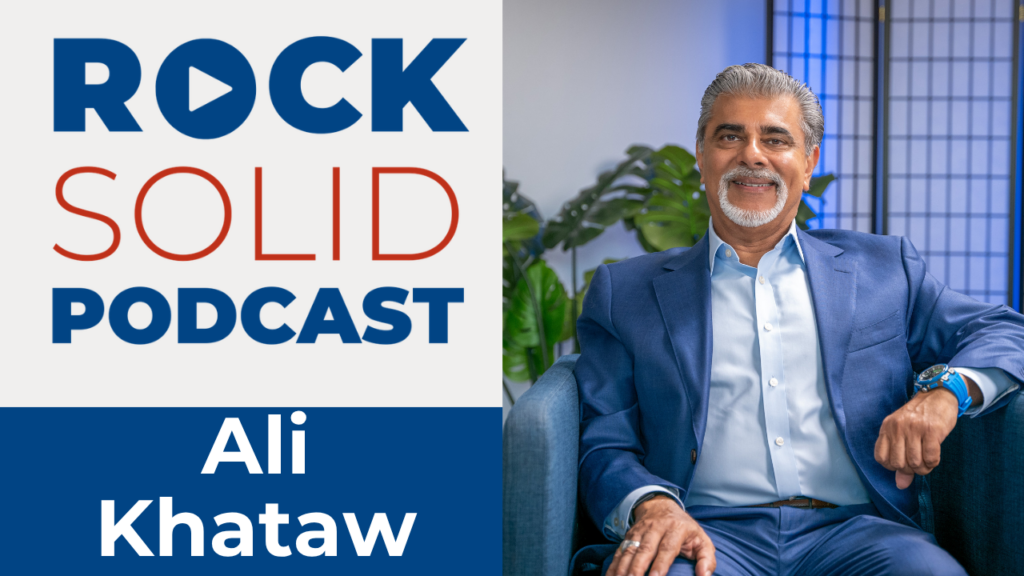
Ali Khataw volunteered to cut his own pay by 10 to 15 percent so his company could grow. He is the CEO of Encotech Engineering Consultants, and the move sounds like a mistake until you hear who suggested it and what it bought him. Read more about Ali Khataw and his career.
Ali came to the United States from Pakistan on his own. He started at the University of Arkansas because it was the cheapest accredited school he could find, then transferred to UT Austin. He started Encotech in 1990. Today the firm has about 45 people and works in eight markets. Along the way he picked up a camera and became a photojournalist, then a photographer who gives profits away.
The moment I keep coming back to is not the pay cut itself. It is what Ali gave up for it. He stopped designing and started selling, and a firm that had stalled at about a dozen people began to grow. He still wanders into design meetings and offers two words of advice. His engineers still tell him it is old code. What he says about a sidewalk in Oaxaca around the 13-minute mark is worth the whole episode, and I will not spoil it here.
For Round Rock founders, this lands close to home. Ali sits on our Chamber board. He is blunt that his boards do not send him business, yet he tells struggling owners to get into the room anyway. His photography hangs in Round Rock City Hall, so you can see the second half of his story in person.
So here is the question Ali left me with. What are you still doing yourself that someone else could do better?
Key Takeaways From This Episode
- Name the one job only you can do: For Ali it was winning work. Everything else needed an owner who was better at it than he was.
- Ask someone further down the road: Ali asked Goodwill CEO Jerry Davis a direct question over a round of golf, then did exactly what he heard.
- Let your team own real work: The firm’s volunteer points game, where only time counted, came from a vice president, not from Ali.
- Show up in rooms, even without an obvious payoff: Ali says his boards do not send him business, but chambers like the Round Rock Chamber put you in front of the people who can change your trajectory.
- Give time, not just money: At Encotech, writing a check earned nothing. Hours spent helping others earned the points.
In Ali’s Words
If money is lost, nothing is lost because you can always make it up. If health is lost, something is lost. But if integrity is lost, everything is lost.
Ali Khataw, CEO, Encotech Engineering Consultants
I’m a man of faith, and I believe the more you give, the more you get.
Ali Khataw, CEO, Encotech Engineering Consultants
The connection is the common thread across everything.
Ali Khataw, CEO, Encotech Engineering Consultants
Episode Chapters
- [00:03] A Chamber friend sits down: Bryan introduces Ali and the thread that ties his work together.
- [01:01] From entrepreneur to giver to photographer: How three phases of Ali’s life led to one idea of success.
- [03:07] Alone in a new country: What it means to build a business, and a life, out of connection.
- [05:06] Lessons from an isolated community in Pakistan: Why visibility matters when you are trying to be heard.
- [09:48] Getting people to open up across a language barrier: The sculptor, the translator, and the article called Hands That See.
- [12:30] A moment on a street in Oaxaca: The scene that made Ali put his camera down.
- [13:30] How Leadership Austin changed him: Ali explains his shift from controlling to collaborative.
- [15:20] Why everyone gets skin in the community game: The volunteer points idea that won an Austin Chamber award.
- [17:28] What integrity means to Ali: A lesson from his father and a story about what is lost.
- [20:06] The 10% pay cut question: Jerry Davis gives Ali the advice that changed Encotech.
- [21:45] What Encotech builds: Eight markets, 45 people, and a long list of Austin landmarks.
- [23:12] Photo philanthropy: How workshops fund giving in Tanzania, Kenya, and beyond.
- [25:24] Ali’s last piece of advice: One idea he wants every listener to leave with.
Frequently Asked Questions
Who is Ali Khataw?
Ali Khataw is the President and CEO of Encotech Engineering Consultants, an Austin-area engineering firm he started in 1990. He serves on the Round Rock Chamber board, has chaired the Austin Chamber’s board, and is a photographer who donates profits from his work to good causes.
What does Encotech Engineering Consultants do?
Encotech provides mechanical, electrical, and structural engineering for buildings and infrastructure. Ali says the firm has about 45 people and serves eight markets, including civic, healthcare, multifamily, transportation, and aviation work. Its projects include the Austin Central Library.
How did Ali Khataw grow his company past 12 people?
Goodwill Industries CEO Jerry Davis asked Ali whether he would take a 10% pay cut for a year, stop doing engineering, hire great engineers, and focus on business development. Ali followed that advice and the company began to grow.
What is photo philanthropy?
Ali uses the term for photography that gives back. He earns income mainly from photo workshops in places like Tanzania, Kenya, Morocco, Indonesia, Cuba, and Pakistan, then donates to causes such as wildlife conservation and a Tanzanian student’s university application.
Why does Encotech have employees volunteer during work hours?
Ali says employees would not show up on weekends, so the firm runs community activities during office hours. A points game rewards time spent helping others, which Ali says builds leaders and compassionate employees. It won recognition from the Austin Chamber.
About Ali Khataw
Ali Khataw is President and CEO of Encotech Engineering Consultants, an Austin-area mechanical, electrical, and structural engineering firm he started in 1990. Born in Pakistan, he studied engineering at the University of Texas at Austin. He serves on the Round Rock Chamber board and is a photographer who donates profits from his work to good causes.
Connect: UT Austin alumni profile | Encotech Engineering Consultants
More From Rock Solid
If this episode resonated, hear Kristin Stevens on Answering Growth With Welcome and Jenn McPeak on Recovery Over Hustle. Both explore how Round Rock leaders handle growth. Browse more leadership conversations and Round Rock Chamber stories.
Watch or Listen
Full Episode Transcript
Click to read the full transcript
Bryan: Welcome to Rock Solid, the Round Rock Business Leaders podcast. Join your host, Bryan Eisenberg, as he explores the journeys of entrepreneurs and companies across Round Rock, Texas. From startups and nonprofits to large organizations, each guest shares their passion for doing business in this thriving community. Let’s dive in. Hi everybody. Welcome to Rock Solid. I’m Bryan Eisenberg and I’m joined today by my fellow Round Rock Chamber board member and friend Ali. How are you doing,
Ali: Bryan? I’m doing great. Thank you.
Bryan: I’m so excited to have you here today because there’s first of all, you know, I hope we can squeeze everything the depth of your experience and knowledge and wisdom and your journey more than anything into this short episode. But I want to start with a very important part because you know, yes, I mentioned you’re on the board of Round Rock Chamber. You’ve been involved in multiple other boards. You’re the CEO of Encotech Engineering Consultants. You’re a photo philanthropist. What’s the thread that binds this current version of you together?
Ali: Bryan, I think it’s a journey. It’s different phases of my life got me different experiences and when I was starting Encotech in 1990, we’ve been in business for 35 years, it was a different Ali, right, because it was an entrepreneur trying to make something work. When things started working I had a little bit more time. I wanted to give back to the community that made my company successful and so I got on boards and had a fantastic opportunity to become the chairman of the board for the Austin Chamber of Commerce. And then of course I love Round Rock and I’m involved here now. But then it got to the point where photography was always my passion. I think that started when I was 16 years old when my dad bought me a Russian camera and I started taking pictures of flowers and I could blur the background and it was just like wow. So that just built up. I was born in Pakistan. When I came to the US I first went to the University of Arkansas because it was the cheapest accredited university I could find, and then I spent two semesters and took a transfer to the University of Texas at Austin. But more interestingly, when I was there I worked for the newspaper as a photojournalist. It was called the Arkansas Traveler and a lot of my images came on the front cover. So I have that photojournalistic instinct that I enjoy and I’m using it more and more now. Instead of taking individual photos I’m trying to do more of a body of work with stories. So it’s been a journey.
Bryan: Oh for sure. We all go through those journeys but to me the most interesting journey you have, I think most relevant to a lot of our listeners, is you came here alone. There’s talk about your early days in the 1980s when you arrived here, how alone you were, how when you started your company you were just getting these little 3D renderings and now you’re the CEO of this company. You’re going around the world. Your photographs are in city buildings in Austin and now in Round Rock as well. And you’re doing all of this other work. How do you reconcile that growth pattern from that lonely entrepreneur to now everything seems to be about seeking connection?
Ali: It’s the funny thing, the connection is the common thread across everything, right? From business development, it’s a connection. When you go to photograph at a location, you’re in this village and you want to photograph in a natural environment where it’s candid and it’s their lifestyle. Again, it’s a connection. You’re building a connection with somebody. I feel like that is something that I’m good at, I feel like I can do that and I enjoy it. That’s the best. And humanity has become my thread right now. I want to make sure my employees succeed. I want to make sure they’re doing well. Affordability is not a major issue for them. These are concerns, right? But then you play that into photography as a humanitarian and it just works. It gives you that feeling inside that you know what, I’m not just taking, I’m giving back too.
Bryan: You and I have spoken about some of the communities you’ve shot in, in Cuba and in Pakistan and across the globe, Africa, and you’ve shot in communities where they certainly could feel isolated and alone. That’s a feeling a lot of entrepreneurs are used to, unfortunately. And I’m sure you remember those earlier days when the business wasn’t so successful. What are the lessons you can take from photographing a community like that, the one you talked about in Pakistan, that you would love to share with entrepreneurs who may be feeling alone today?
Ali: That’s very interesting. Let me think. I think you’re referring to that piece that I did that got published in LFI magazine on transgender people of Pakistan, right? They’re isolated. They’re in a community where they live and I went and sat with them a whole day and photographed them and listened to their stories. They were fighting for their rights. And to do that, you have to have some medium where you’re visible. It was very interesting with the transgender folks because Pakistan is one of the few countries in the world which actually recognizes a third gender on all legal documents. So how did they get that there? Pakistan being a very Islamic country, they went to the clergy and the clergy realized that here is a group of people that are like that not due to their fault. It’s not a choice that I’m going to be a transgender.
Bryan: They were created this way.
Ali: So shouldn’t the creator be more responsible for its creation? Something to think about, right? So that was the angle, and nearly 50% or more of clergy in Pakistan are supporting this idea and that’s why the whole recognition started and then they got their rights. I think for entrepreneurs getting out there with their ideas, because entrepreneurs usually have this secret sauce of something that they have in their mind that they think is going to make them very successful, right? And if you haven’t failed, you’re not an entrepreneur, because it’s a standard thing. I’ve done stuff where I have failed, right?
Bryan: Plenty here, too.
Ali: Yeah. So I feel like being there and being vocal. Yesterday I was in Hays County and there was a fantastic event by the Hays County and Caldwell County Economic Development Corporation, and there were I think seven or eight entrepreneurs in the defense industry in central Texas giving a 30-second pitch of what each one does. Just listening to their original ideas, they were getting exposure to the whole community, folks from all over, from Round Rock. In fact Jessica from Scalian was with me. So I feel like there should be exposure, some angle of actually going there and being original in something and pushing it forward. I believed in the transgender people. I wanted to support them somehow, so I went out on that limb and did this article. Similarly, you have to push as an entrepreneur. The other thing, again, is visibility. I would say pretty much.
Bryan: It’s interesting. Some common threads have come up in discussions the last few weeks. Obviously AI is changing a lot of what’s going on in the world today.
Ali: Right.
Bryan: I’m sure in your business and industry too, and some of the boards you’re sitting on. But the one thing that keeps people uniquely them is them. It’s you. It’s what you have in your story, right? So many entrepreneurs just seem to be afraid to share their story and their failures and their successes. It’s a real struggle for people to look in the mirror and see themselves. How, as a photographer, do you help people see themselves for real? Because I imagine a lot of those people that you photograph don’t see themselves as this grand photograph, and then you take a picture of them and they’re amazed.
Ali: I do share my images also. That’s the best part about Instagram and social media, right? People can connect with you. They can message you back saying, “Hey, by the way, that photograph that you just posted, I would love to have a copy.” So I follow through. But really to get people to open up and see their real self is not that easy. Let me tell you why. Because of the language barrier. That has been a challenge. I did this article that was published in Toto magazine. I had several articles printed on the front cover of that magazine, which used to be a local Austin magazine. This was in Oaxaca, Mexico. Typically where I go to do a story or photography, I usually have a fixer. That’s the industry standard term. They help me arrange and connect what I want to do. So I wanted to photograph this sculptor who was very Mexican, the way he dressed with his hat.
Bryan: Yeah. They’re very native.
Ali: Very native looking. And he lost his eyesight completely when he was 18 years old. But he’s a sculptor and his inspiration is his wife. So how do I photograph that, right? I had a recording on and I had the fixer with me and we recorded the whole conversation and she would translate it for me. Interestingly, when I came back, I took all that recording and converted it into text in English and then took that conversation into an article that was published. So it’s not very easy, but when we were with him I did ask very probing questions. When did you lose your eyesight? How is your wife your inspiration? And in that photograph with the wife, I took that photograph, the wife is standing behind him.
Bryan: I think I’ve seen the picture. It’s a very emotional picture for me.
Ali: And the article is called Hands That See.
Bryan: And so again, a title that would be interesting to read, right?
Ali: I think just asking people probing questions and making them feel comfortable. I had to spend a whole day, right? There were a lot of conversations which were frivolous, I would say, but I got to know his personality.
Bryan: Mhm.
Ali: Similarly, another article I did, which I have not published anywhere, I have kept it for myself, is in Oaxaca again. I love Oaxaca, Mexico. I made another trip there where I wanted to photograph Semana Santa, and this young kid who plays Jesus Christ was a 21-year-old civil engineering student. We connected very well, being a civil engineer myself. The connection was very deep, and after a couple of hours of casual conversation I started asking probing questions. Why do you do this? They’re going to beat you up, there will be blood on your back, you’re going to be whipped, because that’s how they reenact the whole scene. It was amazing to listen to his answers and just feel connected. There was a moment where my wife was with me and I was photographing, and he’s standing in the street, beaten up, there was blood and all that, and there are these ladies dressed up as nuns, which basically would be Mary, and they were actually crying. This was not acting, they were crying and they were hugging him. At that moment, I lost it. I put my camera on the sidewalk and I sat down. I started weeping. I mean, not just crying, I was weeping and it was very emotional for me. So I love to do these kinds of photography trips where there’s some angle of humanity and emotional movement for me. It makes me move. It makes me just feel good.
Bryan: There’s an article written about you and the impact that Leadership Austin had on you and how that transformed you from being a more controlling leader to a more collaborative leader, right? What questions did it evoke in you that caused that change?
Ali: That is so interesting that you read that article. I did my Leadership Austin in 2009 and we were a group of 52 friends, we became friends. The angle that they have is collaborative thinking and community trusteeship. We did a lot of exercises in which we tried to build trust among each other, and at that time my company had I think 10 or 12 people in the firm.
Bryan: Mhm.
Ali: It was small and everything was pretty much the way I wanted it, right? And I was getting into this arena on the business side of what if I was actually doing something where there would be more collaboration and more ideas taken from other folks, because they were all good people working for me and team players. That actually was a turning point. After Leadership Austin, collaborative thinking and community trusteeship became the backbone of what I really wanted to do and I got involved in more organizations. I was invited to be on the board of that organization. I served on that board for 10 years and I was chairman of the board for one year.
Bryan: And that helped you decide that you wanted to make sure all of your employees got involved in community aspects. Why do you feel it’s important for not only the business leader but everybody in the organization to have some skin in the game in terms of community?
Ali: Again, collaborative thinking, right? We sat down one day at our office. Patrick Morrisy is our vice president of mechanical, electrical, plumbing. He’s a principal in the company. We were brainstorming and he came up with this idea. He says, “Ali, what if we made this a little competitive thing in the office? Why don’t we create five or six groups and every group gets a point for every goodness that they do in the community?” Now, serving on boards would not count. Paying money to anybody would not count. It had to be your time. And so we just nailed it. We collaborated and we added all the points at the end of the year and we couldn’t believe how many points we earned. That was a fantastic move. That was the story given to Austin Gives at the Austin Chamber.
Bryan: Mhm.
Ali: And we won in the small business category for this particular thinking and this particular model. Why do we do that and why was it competitive? It was great, but more than that it made all our employees feel good, number one. Number two, they got exposed to stuff they don’t typically get, so going to the food bank and putting in half a day. A lot of these activities we do during office hours.
Bryan: Yeah.
Ali: Because if we do it on a weekend we don’t see a turnout. So the company obviously is losing that time, right, but it is also a time for employees to rise up, and workforce is so important right now. This is how you create leaders and this is how you create compassionate employees.
Bryan: You’ve had all kinds of accolades, all kinds of awards, and you probably have a place in your house or in the office where you have all these trophies. I know that your father and your grandfather had a huge impact on the way you view the world. What would they be most proud of?
Ali: My dad had a stroke a couple of years ago and he has dementia, but he does have old memories still in his mind, and every time I tell him that I won this, I won that, he understands. The smile that I see on his face is priceless. I live by a core value that he taught me. When we were growing up, I saw my dad in action on his integrity. Recently I was a commencement speaker at St. Edward’s University and one of the topics I talked about was integrity. When we were growing up, my dad used to tell us this story: if money is lost, nothing is lost, because you can always make it up and you get time in your life. If health is lost, something is lost. But if integrity is lost, everything is lost. That has been a core value of our family and I say this to my kids. I’m so proud that I have kids who have followed through properly, and they are also compassionate about humanity.
Bryan: Mhm. There’s probably a lot of people who hear what you’re saying and say, “Okay, Ali, it’s really easy for you to talk about this because you’re successful now and you’re giving and all the photographs you do go to philanthropy, but I’m a struggling entrepreneur.” How do you help them reconcile the value of giving to the community and what that would do for them and their business?
Ali: I think it’s exposure also, right? I might not get business from all the boards, and in fact I don’t get business from the boards I’m on, but the chambers of commerce are obviously business-oriented organizations. So my recommendation would be to get involved in avenues that give exposure to business. Of course when you’re starting out, your first thoughts are not going to a food bank and donating. You’re trying to survive and put food on the table. So that’s your priority, obviously your family. But at the same time I think there are great organizations like chambers of commerce. The Round Rock Chamber is run so beautifully. It’s an incredible chamber, and getting involved in organizations, you meet people. I’ll tell you a short story. I was on the Goodwill Industries board and at that time Jerry Davis was the CEO and I admired him because year after year, when we would be looking at our numbers, we would be doubling. It just blew me away. How does he do it?
Bryan: Yeah.
Ali: So I said, “Jerry, I want to play golf with you and I want to get to know you better.” So we went for a golf game. I was terrible and he was very good, but he made me look good. I told Jerry that I don’t know what to do next. I’ve reached about 12 people and I need to grow, and how do I spend my time? And he said, Ali, these were his words, he said, “Ali, are you willing to take a 10% pay cut for one year?” And I said 10 to 15%, no problem.
Bryan: Yeah.
Ali: He says what I want you to do is stop doing the engineering that you do. You’re spending too much time designing stuff.
Bryan: Yeah.
Ali: Hire great engineers. Put them in position. Your skill is in business development. You like to talk to people and engineers don’t have that skill, typically. Most don’t. So I followed his rules completely to the tee and the company started growing and I was out there hustling work whereas other folks in the office were designing. Even now, it’s so funny, there will be some meeting going on in the conference room and they’re looking at a set of drawings and I’ll step in there and put two words into it, and then my engineers will say, “Ali, that’s old code, are you in touch with reality?”
Bryan: Tell us a little bit about what Encotech does, what kind of projects and stuff like that.
Ali: We’re basically right now 45 people in the office. We do mechanical, electrical, structural engineering. So we design buildings and infrastructure. We serve eight different markets.
Bryan: Okay.
Ali: We’re doing a lot of aviation. We do a lot of civic buildings. The Austin Central Library on Cesar Chavez, which is a beautiful project, is our project. We worked on it. Now it takes a team to work on a project. We’re not the only engineers there, but we are engineers involved on the project. Similarly, the butterfly bridge, the beautiful bridge next to it, we were involved with that too. And then [unclear], the boardwalk, and it’s a long list of projects. So we do civic, we do healthcare, we do multifamily, we do transportation, travel and leisure, and I love aviation. We’re pretty good at the aviation industry.
Bryan: Well, I figure you also like to travel.
Ali: I love traveling.
Bryan: I’m not a big fan. I have great ideas for airports. I want to kind of wrap up and talk about your photography a little bit. You call yourself a photo philanthropist.
Ali: Yes.
Bryan: What does that mean for the average person?
Ali: How do I create income for Ali Khataw Photography? There are basically two major ways. One is selling images, which nowadays is very hard, very difficult. The other is workshops. The workshops angle is the one that is working for me. Right now I have workshops going on in Tanzania, Kenya, Morocco, Indonesia, Cuba and Pakistan. Through those workshops there is income generated, and what I do is I look at the end of the year, and even during the year, we try to donate to good causes. I’m going to be heading to Tanzania and Kenya in a couple of weeks with a group of 10 people from Austin, and on that trip we will be meeting a wildlife conservation group that works with elephants and we will be donating money. I have a great partnership with Fair Trade Safaris, a great company. Sorup Katrapal is the CEO, a very good friend of mine, and his company is also photo philanthropic, if there is such a word, I don’t know.
Bryan: There is now.
Ali: He donates 100% of his profits also, so we sync so well in doing this. Sometimes we go to orphanages and then we will donate money there. We just recently donated, Ali Khataw Photography just donated, to help a girl in Tanzania get into a university by giving her computer equipment so she could apply. Things like that. The money making is not a big portion. It’s small money, but it’s the chance to give it out to serve humanity better in some shape or form.
Bryan: I love your recent YouTube video where you walked through and narrated your photography. People can see your photography in the City Hall building in Round Rock, and of course online. If you had to leave our audience with one last piece of advice I may not have asked you about, what would you want to share with them?
Ali: I would want to share with them the joy of giving. Until you do it, you don’t realize it, but it’s incredible. And I’m a man of faith, and I believe the more you give, the more you get. That would be my message.
Bryan: I appreciate you giving your time today and sharing your incredible journey with our audience. If people want to learn more about what you’re doing and get in touch, maybe they have some questions for you, what’s the best way for them to find you?
Ali: (Ali shares his email address, website, and Instagram.)
Bryan: Awesome. Thank you so much.
Ali: I enjoyed this, Bryan. Thank you so much for this opportunity.
This transcript was generated automatically and edited for readability.