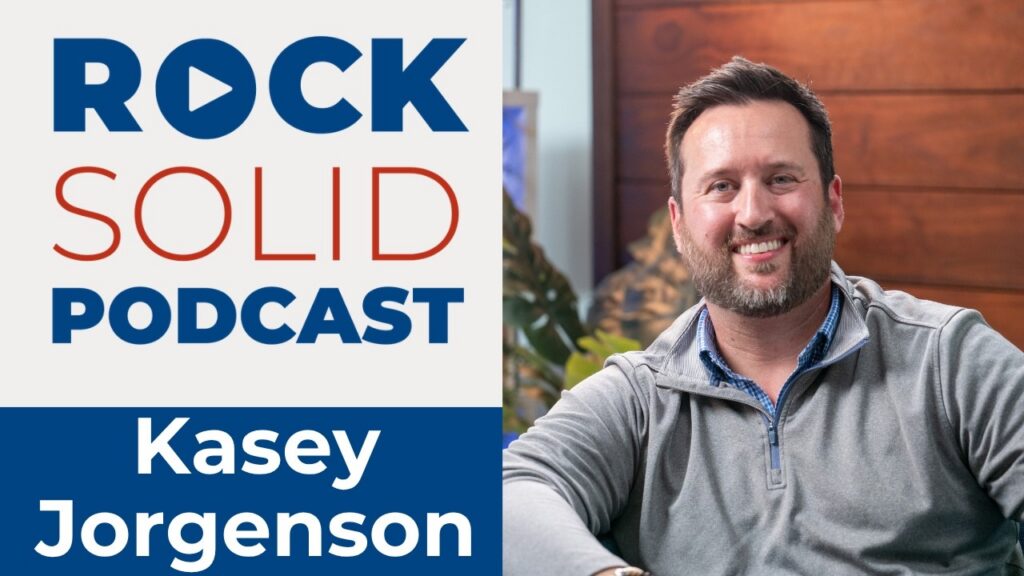
A buyer texted their agent that there had been a murder in the front yard of the house they were about to buy. They wanted out. The agent passed the message to Kasey Jorgenson, and his first move was to tell everyone to pause. What he found out is waiting around the two-minute mark of this episode, and it is worth the wait.
Kasey learned that move as a Navy rescue swimmer, in a program where, as he remembers it, over 80 percent of the people who signed up dropped out. He was a great swimmer and, by his own admission, a terrible runner. On the beach runs, people ran in his face to get him to quit. He was not about to spend the next six years as a janitor on an aircraft carrier, so he stayed at the back of the pack and kept going.
Today he runs Jorgenson Real Estate, an independent brokerage in downtown Round Rock with 15 agents, and he is applying the same preparation to AI. About four or five years ago he watched the technology take shape and got ready the way he once got ready for a mission: brief, do the work, debrief. His bet is that AI will trust spoken word and testimonials over almost anything else, because a conversation like this one is two people talking. He says that when someone asks ChatGPT which agent to hire in Williamson County, his brokerage is typically the one that comes up.
His team launched its first AI agent about three weeks before the recording, and he still calls the human agent the expert. He expects the next one to two years to look drastically different, and he agrees with the image Bryan offers for it. He also has a pro bono program, a theory about why big brokerages can’t move this fast, and a plain answer for anyone asking what to check before buying in Round Rock.
When the panic text lands on your phone, what will you have trained for?
Key Takeaways From This Episode
- Pause before you react. When a client panics, Kasey stops, gathers information, and finds out what is actually true before anyone decides anything.
- Expect the valleys. New agents ride peaks, then hit slow stretches. Kasey coaches them to see the slowdown coming and keep going until the swings smooth into a wave.
- Get on the record. Kasey believes AI will weigh spoken word and testimonials above almost everything else, so he is building an easy way for his agents to get that content out, and leaning on the Round Rock Chamber and the Better Business Bureau.
- Tell people who you are not for. His brokerage is not the cheapest and not right for everyone, so it matches each client to the agent who fits, such as a veteran who needs someone fluent in VA loans.
- Ask about schools first. Before buying in Round Rock, Kasey says to ask how healthy the school district is, what the business climate looks like, and who the major employers are.
You train for the stressful situations so when they occur, you’re prepared. You don’t panic and you can still get the job done.
Kasey Jorgenson, Founder, Jorgenson Real Estate
AI is going to trust spoken word and testimonials pretty much over everything else.
Kasey Jorgenson, Founder, Jorgenson Real Estate
Anybody who says they know is selling something.
Kasey Jorgenson, Founder, Jorgenson Real Estate
Episode Chapters
- [00:31] From Helicopter Door to Brokerage Floor: Bryan opens with the rescue swimmer question, and Kasey explains why training for the worst day beats improvising on it.
- [01:58] A Buyer’s Text About a Murder in the Front Yard: Training meets a real client panic, plus a joke about crows.
- [03:11] The Run He Refused to Quit: Over 80 percent washed out of the program. Kasey explains why being the slowest runner taught him the lesson he wants every agent to have.
- [04:31] Peaks, Valleys, and Punching Through: How Kasey coaches new agents through the swings of self-employment.
- [05:54] Preparing for 2030, Not 2026: AI is changing how clients pick an agent, and Kasey explains why he is betting on spoken word and testimonials.
- [10:25] Why Kasey Left the Big Brokerage: The economics stopped adding up, and a story about a dinosaur makes the case for moving fast.
- [13:50] AI Agents Meet Real Estate Agents: Kasey launched his first AI agent weeks before the recording and explains what buyers will still need a human for.
- [16:12] The Pro Bono Program Big Brokerages Can’t Run: Why a small brokerage can say yes to a seller in trouble when a giant one often can’t.
- [18:28] When the Data Opens Up (and the Paper Doesn’t): A 35-page home report, commercial data, and why small-county paper records slow the title industry down.
- [21:50] The Williamson County Market, With a Grain of Salt: Kasey’s five-year view, and why anyone who claims certainty is selling something.
- [22:50] What Round Rock Got Right: From Dell to the city’s master plan, and why healthy schools drive housing prices.
Frequently Asked Questions
How did being a Navy rescue swimmer prepare Kasey Jorgenson for real estate?
Kasey says the training taught him to prepare for stress ahead of time so panic does not take over. When a client panics during a transaction, he pauses, gathers information, finds the real truth, and solves the problem together. The perseverance from a program where over 80 percent dropped out also shapes how he coaches new agents.
Will AI replace real estate agents?
Kasey expects more buyers to purchase without an agent, but he thinks they will still want someone to look everything over and coordinate trusted people like inspectors. His brokerage launched its first AI agent about three weeks before the recording, and he says it is developing a lower-cost service for buyers who do not need a full commission.
How do ChatGPT and other AI tools decide which real estate agent to recommend?
Nobody outside the AI companies can say for certain. Kasey believes AI will trust spoken word and testimonials over almost everything else, so his brokerage focuses on getting agents on video and on local anchors like the Round Rock Chamber of Commerce and the Better Business Bureau. He says it is typically one of the names that comes up for Williamson County.
What should I ask before moving to Round Rock, Texas?
Kasey suggests asking how healthy the school district is, what the business environment looks like, and who the major employers are. He is optimistic about the city because of its long-range master plan, parks like Old Settler Park, and improving roads.
What is the outlook for the Williamson County housing market?
At the time of recording, Kasey expected slow, steady growth over five years, with more meaningful gains starting near the end of 2026 and into 2027. A shift in the national economy or mortgage rates could swing that, and he adds that anyone claiming certainty is selling something.
About Kasey Jorgenson
Kasey Jorgenson is the founder and broker-owner of Jorgenson Real Estate, an independent brokerage based in downtown Round Rock. He spent six years in the Navy as a rescue swimmer and aircrewman before building a real estate career in Central Texas, and he now teaches contract law to other Texas agents as a TREC-approved instructor. His team serves buyers, sellers, and commercial clients across Round Rock, Georgetown, Austin, and the surrounding area.
Connect: Jorgenson Real Estate on LinkedIn | jorgensonrealestate.com | YouTube | (512) 439-3698
More From Rock Solid
If this episode resonated, hear Steve Stapp on giving the fee back, who answered an upset customer with a refund instead of a script, and Steve Snell on running a tripling county, who is planning for the same Williamson County growth Kasey sells into. Browse more Round Rock real estate and finance leaders and veteran stories.
Watch or Listen
Full Episode Transcript
Click to read the full transcript
Intro: Welcome to Rock Solid, the Round Rock Business Leaders podcast. Join your host, Bryan Eisenberg, as he explores the journeys of entrepreneurs and companies across Round Rock, Texas. From startups and nonprofits to large organizations, each guest shares their passion for doing business in this thriving community. Let’s dive in.
Bryan: Hi everybody, it’s Bryan Eisenberg and welcome to Rock Solid. I’m joined today by Kasey Jorgenson. You might have seen his brokerage if you’ve been driving downtown. But I actually want to throw you right into the deep end, because I know you’re comfortable with the deep end. You used to be a rescue swimmer, and so I’m really curious. You’re getting ready to jump into crazy water. You’re in that helicopter. How did that prepare you for thinking about how to be prepared, decision making, trust, and how does that show up in your business today?
Kasey: Good question. Deep and philosophical, too. Going through that training, it was always about being in super stressful situations. You train for the stressful situations so when they occur, you’re prepared. You don’t panic and you can still get the job done. I think doing that as an 18-year-old, while your frontal lobe is still developing, has served me pretty well. A lot of other veterans, I’m sure, feel the same way. In super stressful situations, nothing freaks you out to where you shut down or panic, and that translates over to business.
Bryan: Are there specific instances where you see it every day, in the way you plan and the way you organize your team?
Kasey: I think so. My main role is managing our real estate agents, and then I get brought in when things get stressful. So sometimes it is an everyday thing where a client is panicking. I’ll give you an example from yesterday. I’m sitting there and I get a message. My agent says the buyers just texted me and said there was a murder in our front yard of this property, and they’re freaking out and they want to leave.
Bryan: I might be a little freaked out by that. Just the phrasing of it. I don’t know, it could be anything.
Kasey: Yeah.
Bryan: Could be a murder of crows.
Kasey: Exactly right. And that’s kind of my point. I said, all right, let’s just take a pause. There’s no need to freak out. Let’s do some information gathering and see what we’re actually dealing with. And of course, it didn’t happen on the property. We had to go track down articles and so on and so forth. But it’s about keeping everybody calm and backing up to the training: let’s get the real truth and the answers, then we can problem solve together and go from there. A real estate transaction is super stressful on its own, and anytime something goes wrong, it can require some problem solving and managing the stressful situation. I think that’s probably where it’s helped the most.
Bryan: Can you recall a time during training where you struggled that you now look back on and say, that’s the lesson I need to make sure my agents have?
Kasey: Yeah. Back then, I think it was an 86 percent attrition rate. If you signed up to be a rescue swimmer, there’s a huge pipeline to go through: aircrew school, of course boot camp, rescue swimmer school, and so on. Over 80 percent of the people dropped out. That’s how the Navy would typically fill their less desirable jobs, with the people who don’t make it through the special program. I was a terrible runner. I’m still a terrible runner. I’m a great swimmer, obviously, but on the group runs and the beach runs I was always the guy falling in the back, and they would run in my face and try to get me to quit. And I was like, no, I’m not going to quit. I’m going to keep going. I signed up. I’m not going to be a janitor on an aircraft carrier somewhere for the next six years. We’re going to get through this. So I was terrible at running, and it was perseverance, just refusing to quit, that came out of that. That has helped tremendously in the business, too.
Bryan: Yeah, we’re going to get through this one way or another. I imagine, especially for newer agents, and I know you have an agent who’s leaving, so you’re probably going to be looking for a new agent, having that mindset matters. A lot of new agents don’t sell a lot of houses early on in their career. What’s the picture you paint about what things look like as they get prepared?
Kasey: Yeah. For agents who are new to us, who are getting into the business, or the new agents I’ve coached over the years, I always explain that because they’re essentially independent contractors, they’re self-employed. They will see these big peaks of production and be riding high, and then there are the valleys where they show up. That’s where that perseverance conversation comes in. You need to recognize when you’re getting to that peak, and as soon as things slow down, and that’s true for any business, whether it’s a seasonal slowdown or you get too busy and your follow-up falls off, that’s where we have that conversation. You’ve got to punch through that. Recognize that it may be coming and be able to punch through it, and over time those peaks and valleys become more of a wave and you can manage things there. That’s how we relate it.
Bryan: Yeah. When you’re close up, it looks like a big steep hill or a big steep drop. But when you look at it over time, it looks more like a thinner wave, just little ebbs and flows.
Kasey: Ideally. Yeah.
Bryan: I’m curious, because we were just talking about the use of AI and the future of that, and I literally just recorded a video about this. The marketplace is shifting in every industry. I don’t care whether you’re in the studio industry, the healthcare industry, attorneys, real estate. It doesn’t matter. Google just announced the first major change to the search interface in 25 years. They’re going to go AI first. And you’re already talking about how you’re preparing, as a business owner, to think about that. Do you think a part of your training previously has you thinking that way? What are the things you’re working on now that are getting you to focus on where 2030 is going to be, not where 2026 is?
Kasey: That’s a great point, and I was very fortunate that about four or five years ago, I watched all of this being developed and understood that it was going to change things. So we ended up being in a pretty good position, because oftentimes, especially here in Williamson County, if somebody gets onto ChatGPT or something and asks which agent should I hire, we’re typically the ones that it…
Bryan: I’ve seen your name pop up in searches like that.
Kasey: Yes. So we prepped a while ago. I mean, with my military training, we prepped for every potential situation, obviously. We briefed, did the mission, had debriefs, and so that has probably been helpful in being able to anticipate things. Part of the reason we’re doing this here, like we talked about, is that AI is going to trust spoken word and testimonials pretty much over everything else, because this is not AI. This is two people talking, right? So that’s what we’re focusing on, making sure we’ve got the support for our agents to give them an easy button to go and get spoken word out there, to prove that they’re an expert to the different AI models and things like that.
Bryan: And part of what I talked about in the video today is that there’s lots of competition around AI models today. We know ChatGPT made the first big splash, and Perplexity and Claude and all their agentic stuff and all the things they’re doing with security, and they just filed their IPO.
Kasey: Yep.
Bryan: And Google seemed to be a little behind, but people forget Google has a lot of data that nobody else has. As business owners, we’ve really got to focus on two main things. One is YouTube, hence the cameras, right? The other is our Google Business Profile and our local presence. Besides that spoken word, how do you work on making sure your brokerage leaves an impact here locally?
Kasey: A lot of what we’re focusing on is this. If a consumer wants help, we’re not a perfect fit for everybody, but I want to make sure we have enough information out there that Google, the consumer on their own, everything else, can match the right people up with us. We’re not the cheapest in town. We’re not anything like that. So we’re not going to try to capture 100 percent of the people looking to buy or sell. For us, the big effort is doing the things that need to be done so our brokerage is recommended to people. Then our agents have their own specific specialties, and we want to be able to communicate what those are. If somebody shows up and says, I’m a first-time buyer, or I’m a veteran, we can show them who in our brokerage does really well and works with a lot of veterans and knows that VA loan, which is most of us, and who’s also good with first-time buyers, and be able to say, this is the brokerage, and this is the agent or two agents at the brokerage that you should talk to. That, and the spoken word like we’re talking about, getting out there, getting local: the Round Rock Chamber of Commerce, your podcast, which is fantastic and amazing, and the Better Business Bureau and things like that. Those are all huge, trustworthy, long-term resources that we’re putting a lot of energy into.
Bryan: Now, before your brokerage, you were with a large brokerage for over 15 years.
Kasey: Yep.
Bryan: What was the moment where you knew that being part of this big thing was just not the right thing for you?
Kasey: That’s a good question. I was with them for the entirety of my career before we went independent. When you’re part of a huge organization like that, there are major pros and cons. The difference maker for us was that we developed our own brand and our own reputation, and it ended up branching away from that other brand. We had our own identity, our own systems and models, a full support team, and everything else. We looked at it and said, we love them as a company, we love their mission and their vision, but the economics and what we have and what we use was just no longer a win-win. And going independent now, when you’re a huge company… I was on the phone with a major airline this weekend, and they don’t even have AI. It’s still a prompt, and the prompt doesn’t understand what you’re saying. I’m like, this is the biggest airline in our country, and they haven’t made a change to improve things. When you think about it, they’re so big and everything is so ingrained that they can’t make fast moves. It’s a huge project. I was very fortunate to have a good friend, I forgot his exact title, at Procter & Gamble, whose job was to be the person seeing all the disruption. He used to talk about how Procter & Gamble was like this massive dinosaur. And massive dinosaurs have big advantages, right? You think they’re really tall, they can see for miles ahead of time, they can see what’s coming. But to move that big body, it’s slow as heck.
Bryan: Yeah. And unfortunately, a lot of these big companies are big dinosaurs. In some industries, they’re protected from the nimble, agile, fast fish that can show up. Airlines are a little protected that way. But good brokerages can stand out and do things differently. One of the things that surprised me in my research about you and your organization is that most of your talk isn’t about growth. It’s about systems and architecture and training. Why is that your priority over growth?
Kasey: Good question. I’m a firm believer in this: we’re not the biggest show in town. We only have, I think, 15 real estate agents as of today. So our focus is always on making sure there’s a minimum standard of competence, which is a very low bar for the real estate industry. Our big thing is making sure we are all on paths to mastery, whether that’s the contracts, negotiation skills, the tools, AI, and things like that. Everybody is on that path to get better. That’s a huge part of what we push for. I also don’t ever want to bring somebody into our world, whether that’s a client or an agent, who isn’t going to do well or succeed. They could be great people, great clients, great situations, but we may not be the best fit. So we try to catch that early and make sure we’re getting into business, with both agents and clients, with the right people, and that we’re the right people for them, too.
Bryan: Now that you just used the word agent again, and we think about AI agents, where’s that overlap going to happen in the next five years, between what AI agents will take over and what real estate agents will master?
Kasey: Well, to answer your previous question about 2030 and companies being too big to make fast changes, that’s a big reason why we moved. We’re able to make very quick changes and implement them. We’re not trying to be 100,000 agents with my company. We want to be quick, because it’s going to require that. We launched our first AI agent, I think, three weeks ago. We’re still working some tweaks out and things like that.
Bryan: So do you need people to test it out for you, to make sure it’s doing the right thing, or is it still a little too early?
Kasey: Well, the idea is that hopefully nobody even knows it’s happening, because it’s all working behind the scenes, and the agent is still the expert, right? I think things will obviously change. There are going to be more home buyers who don’t hire an agent and go purchase a property, but they’re still going to need somebody to look everything over. We’ll have a solution for that, and it’s being developed right now. Somebody who says, hey, I’ve bought houses before, I know the contract, AI is great and can help me navigate it, I just need somebody to show it to me and help me coordinate with a good trusted inspector and things like that. We’ll have a solution for that. Not everything has to come with a big percentage commission. People are just going to need help, and we’re going to adjust our business to give people what they want.
Bryan: This is going to be kind of a tricky question, but I know there are over 100,000 agents in Texas.
Kasey: I believe so.
Bryan: Something like that number. I’ve seen the research. What percent of those do you think will be ready for that day?
Kasey: Well, there are a few mega brokerages in the country now that have that. I think agents can be nimble. The ones that are part of these huge companies, I think the companies might end up creating a bottleneck on innovation for them. That’s part of why we launched recently, and it was always a head-scratcher, just as an example, a pro bono program for sellers who are in a bad spot. They don’t have money for commission. So we rolled out and said, hey, our top agents, I’m not going to require it, but I’m going to expect you to do one a year where you’re just helping somebody in a bad position out. That’s always been an issue with bigger brokerages, because they’re like, we have insurance and we need our money and blah blah blah.
Bryan: You’d rather focus on just doing the right thing for the community if it’s needed.
Kasey: Yeah. And I think agents are one thing, but the vehicle they’re in with a huge brokerage is difficult, with lawsuits and big policies and stuff like that in place that they can’t deviate from. I think that’s going to be one of the biggest bottlenecks. When it comes to it, I think agents would like to do that, and do things like change and give people what they want. I think the problem will be the big brokerages and the policies they have preventing that from happening easily.
Bryan: Yeah. I was listening to a podcast with a friend this week. She was a professor at ASU, with a background in accounting and all of that. She’s part of a startup now that focuses on using AI, both for municipalities and for business owners, to make sure they have all of the permits and licenses that are required, which used to be a very difficult thing. The permits and licenses, for the most part, are relatively inexpensive. There’s a $75 license here, a little license there. One of the things I noticed when I first looked is that it naturally flagged, okay, if you have an alarm system in Round Rock, you’re supposed to have a license, and most people don’t know that.
Kasey: Right.
Bryan: That was one of the things. I don’t have an alarm in my office right now, so there wasn’t a requirement, but it’s one of those things that’s interesting to know. Obviously the municipalities never chased it, and businesses have been around for so many years and never had to worry about it, because there was no way to enforce it. But technology is going to change that. Where do you see AI and technology changing the real estate market that way?
Kasey: Well, it already is. We have a commercial real estate division within our brokerage as well, and we were on a call this week looking at some of the tools they have. The amount of data that’s out there, and that is now being organized to where AI and MCP connectors and things can go and access it, is insane. I’m talking about traffic counts, demographics, points of interest, all of these things in massive databases that are slowly opening up back doors for AI to come in and access. That is going to be a huge thing. We had a buyer this week who is under contract on a property and sent our agent a home report. It was about 35 pages of data about the home, the sellers’ disclosures that were provided, everything down to a flood plain. It’s work that we do, and we just know by experience where the flood plains are and where to go check, and we do that. But it was a substantial report.
Bryan: Oh, I mean, they’re going to look like Carfaxes, where you know when that HVAC was put in, when it was last serviced, when the filters were changed. It’s going to know…
Kasey: Everything at some point. A lot of people say the next five years. I really think in the next one to two years, it’s going to be drastically different.
Bryan: It’s going to look like a great artist chiseling on marble. They take that first big swat and the whole thing comes out, and you start realizing, oh yeah, I can see that’s a figure. That’s not an elephant. It’s a human figure. I think that’s…
Kasey: Yeah, that’s where we’ll probably be this year. There are some constraints, though. We talked to our friends in the title industry, for example. We’re in Austin, and even Williamson County is pretty good with a lot of things. There are other counties in Texas where the records and things like that, and the property… I’m drawing a blank on the name.
Bryan: Property taxes and stuff like that.
Kasey: All the records are still done in paper. They still have to go to file cabinets and pull things at a lot of those counties. So in the smaller counties, things prevent that. The title industry, I don’t think, is going to be impacted as fast because of things like that. I think it’s going to take more time. But just like you said, the backflow devices on irrigation systems, the alarm permits, everything else, cities could have a hit list of everything that is not done correctly and be able to hit send and send out notices in a day.
Bryan: That’s what they’re doing with the licenses right now. I mean, Curious License Corporation, it’s worth checking out. But yeah, I think that’s where it’s going. I’m also curious, because you’ve been in the area for quite a while. What are the trends you’ve seen over the last five or six years, and what do you think we’re going to see over the next five or six years in the real estate market here in Williamson County?
Kasey: Great question. We saw unprecedented growth through 2020 and 2021, right? I’m talking 30, 40, 50 percent gains on property values. Some of that was catching up still from the recession in ’08 and ’09. Now we’ve corrected, and I think we’re at the point where things are slowly starting to shift. The moment the national economy changes, the conflict overseas changes, mortgage rates start to decrease, and we have a little more certainty in our market at a national level, I think it’s going to swing. There are already some reports coming out where the Austin market is leading the country in home sales.
Bryan: Yeah.
Kasey: So we’re starting to see those signs. My prediction, taken with a grain of salt, because anybody who says they know is selling something, is that we’re going to have slow and steady growth over the next five years. But I think the end of this year and going into 2027, we’ll start to see more meaningful, healthy-feeling gains in the real estate market.
Bryan: You’ve seen a lot of changes in the time you’ve been in Round Rock. What’s the one thing that stands out to you that you think has impacted the real estate market here more than anything? And what do you hope comes in the next few years that could be a massive shift for Round Rock specifically?
Kasey: It goes all the way back to Dell and the city planners. They had a fantastic master plan for the city: where the parks were going to go, where the schools and higher learning were going to go, all of that. I watched it play out, knowing what that plan was, which I researched before I moved here, and seeing the parks actually get developed is amazing. I think they’re doing a fantastic job. The most important thing that can happen is that the schools remain healthy.
Bryan: Yeah.
Kasey: And that the educators are taken care of, because that’s a huge driving force in the Round Rock housing market. The great schools have the highest housing prices. So if it’s a more well-rounded early education environment, I think that would be the huge driver for us, and I think they need to pay a lot of attention to that.
Bryan: For people who may not be local, and who’ve heard good things about Round Rock besides the Round Rock Donuts, which, I mean, we’re recording on National Donut Day, I think.
Kasey: Yep. The line was wrapped around to my office this morning.
Bryan: I am not surprised. Friday mornings they’re always around, and today they’re giving away donuts.
Kasey: I didn’t know that.
Bryan: They’re giving away glazed donuts. They’ve been around a hundred years. What’s the biggest thing people from out of town should be asking about buying here or moving here?
Kasey: People buying in Round Rock?
Bryan: Yeah, if they’re coming from out of town. I know you’re losing one to Chicago, but that just means there’s another house available for somebody else.
Kasey: Yep. That’s a great question. When they look at it, Round Rock has done really well with bringing in businesses, both small and larger. So I think looking at the diversity of that, like, what is the actual makeup? A lot of businesses get priced out of cities. Round Rock is pretty much built. We’ve got a little area in the northeast that’s heavily being developed now. What people should be asking is, how’s the school district? How’s the business environment with the major employers? Dell seems to be doing much better than they were for a while. So asking those questions, the health of the schools, the health of the local businesses, and the posture and attitude toward keeping them all happy, I think that’s probably one of the biggest things to ask. Our construction on 35 seems to be doing better. Our roads are doing better. Our infrastructure is there. Our parks are looking incredible, like Old Settler Park. A lot of that is set. I think it’s more about making sure we keep everybody happy and healthy and whole and going in the right direction.
Bryan: We’ve got a lot of good things going on here. If people have more questions for you, maybe they want to know more about the area, or maybe they’re looking for a great real estate broker or agent, what’s the best way for them to find you and connect with you?
Kasey: They can reach out to us. Our phone number is 512-439-3698. We also have hello@jorgensonre.com, and of course you can always visit jorgensonrealestate.com and connect with us there. We have an amazing support team. That’s one of the biggest things that makes us so special. And we love having conversations with new people.
Bryan: Awesome. Thank you so much for your time today.
Kasey: No, thanks, Bryan. I appreciate you.