
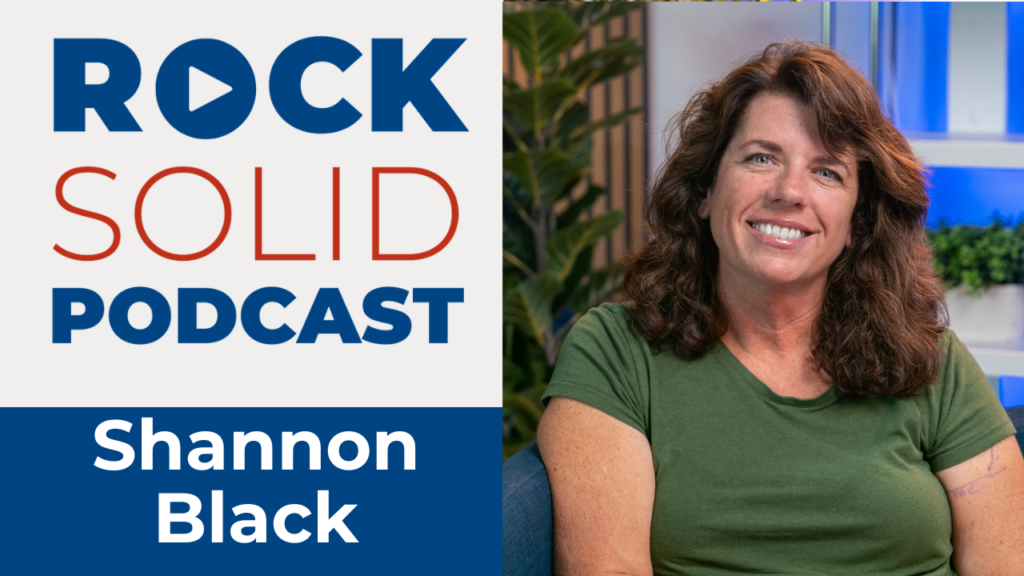
Most podcast guests arrive and talk about their business. Shannon Black arrived three days after being bit by a rattlesnake. She was gardening in Georgetown, reached under a bush without looking, and a baby rattler got her on the hand. Two days in the hospital at St. David’s Round Rock, antivenenom, no complications. Then she came and sat down with me at Round Rock Studio and talked for thirty minutes about how to hire better people. That combination of toughness and practical wisdom turns out to be exactly what Shannon brings to every business owner she works with through SCORE Austin, where she is chapter chair.
Shannon did not set out to run a nonprofit mentorship organization. She set out to find a good Montessori school for her son. When she couldn’t find one, she built one. That was 2006. She grew Sunrise Montessori to two locations, ran it as a math-teacher-turned-entrepreneur for nearly two decades, and sold it about four years ago at 51. Then she looked around, needed something to do with herself, found SCORE, and discovered an organization that offers something she never had when she started: free business mentoring, workshops, and a network of people who have already made the mistakes you are about to make.
The hiring conversation is where this episode shifted. Shannon developed her system after COVID reshaped the labor market and easy hiring disappeared. Her framework covers when to post (Sunday morning, because Google indexes in 24 hours and Monday lunch is peak job-search time), how to write the listing (shorter, friendlier, with 30-plus hashtags at the bottom that search engines index and job seekers never read), and how to run the interview. That last part is what I keep thinking about. Shannon asks every candidate one question that has nothing to do with the job: what is your favorite color? And then she asks why. The candidate who lights up explaining it, who tells you a story with genuine emotion, is the one who will do the same thing when they are in front of your customers. The candidate whose affect stays flat is telling you something, even if their resume says otherwise.
For Round Rock business owners, SCORE is a resource most people have never called. Shannon’s chapter serves the entire Austin metro area and beyond, offers free one-on-one mentoring with people who have run the kind of business you are trying to run, and hosts dozens of free workshops every month. If you are struggling to find the right people, or even if you have never thought carefully about why the people you hired are not staying, Shannon’s framework gives you something to work with this week.
When was the last time you hired someone who lit up in the interview, and how long did they stay?
Key Takeaways From This Episode
- Sunday morning is the only time to post a job listing: Most employers post whenever it’s convenient. Shannon posts Sunday morning without exception. Google and other search engines take about 24 hours to index a new listing. The peak job-search window is Monday at lunch. If your listing goes up Thursday, you’ve already missed the highest-traffic moment of the week. The second biggest window is Tuesday at 10am. Time your post to hit both.
- Hashtags at the bottom of your job listing are your SEO strategy: Shannon puts 30-plus hashtags at the bottom of every listing, covering every job title variation, every nearby city, and every relevant keyword. Job seekers never read them. Search engines do. This is how you get your listing surfaced in a Google search without having to think about keywords inside the body of your ad. It’s invisible to candidates and essential for discoverability.
- Avoid masculine words in your job listings if you want women to apply: There is documented research on this. Words like “execute,” “dominant,” “aggressive,” and similar terms read differently to women than to men and suppress applications from qualified female candidates. Google what masculine words to avoid in job listings and you’ll get a full list. Removing them costs nothing and broadens the pool of people who feel invited to apply.
- The interview question that reveals the most has nothing to do with the job: Shannon asks every candidate what their favorite color is, then asks why. She’s not looking for a color. She’s watching for the person who tells a story with genuine enthusiasm. The candidate who lights up explaining why black makes pastels pop is showing you how she will talk about your company, your clients, and her work. The one who gives a flat answer is showing you that too.
- SCORE Austin offers free mentorship and workshops for any Central Texas business owner: Two-thirds of SCORE’s clients are just starting and don’t know where to begin. One-third already have a business and have hit an obstacle: a toxic employee, a financial challenge, a lease they shouldn’t sign. If you have been dealing with any of these alone, score.org connects you with mentors who have direct experience with your specific situation, at no cost.
If they don’t light up explaining their favorite color to you, that’s concerning. It’s like, what’s going on? Their affect is wrong. They’re trying to put on a different show.
Shannon Black, Chair, SCORE Austin
Protecting your culture today is probably more important than it’s ever been in the history of hiring.
Shannon Black, Chair, SCORE Austin
Once you set culture up well, it actually self-regulates. When someone comes in who’s not the right fit, the rest of the people make them uncomfortable. They’re like: we don’t do that here.
Shannon Black, Chair, SCORE Austin
Episode Chapters
- [0:00] Welcome and a Rattlesnake Story — Shannon arrives three days after a rattlesnake bite in her Georgetown garden. Bryan opens on the one thing nobody expected from this taping.
- [1:24] Why She Came Anyway (and What SCORE Is) — Shannon explains her role as chapter chair of SCORE Austin, the free mentorship organization that most Round Rock business owners have never called.
- [2:25] From Math Teacher to Montessori Founder — Shannon couldn’t find a good Montessori school for her son, so she built one. Sunrise Montessori grew to two locations before she sold it about four years ago at 51.
- [3:53] What SCORE Actually Does — Free one-on-one mentoring, dozens of free workshops a month, and a national network that can match you with mentors in San Francisco if Austin doesn’t have the right specialist. It costs nothing.
- [5:11] Self-Taught Entrepreneur: Business Books as the Only Mentor — When Shannon started her school 20 years ago, YouTube didn’t exist and she didn’t know SCORE existed either. Business books and experimentation were her whole curriculum. That gap is exactly why she volunteers now.
- [7:00] Who Shows Up at SCORE and What They Need — About two-thirds of Shannon’s clients have an idea and don’t know where to begin. One-third have a business and have hit a wall: a toxic employee, a financial obstacle, a lease that doesn’t make sense. SCORE has mentors who have been in both places.
- [10:33] How to Volunteer as a SCORE Mentor — Five years of business experience is enough. Shannon explains how to search for mentors by keyword and background, how virtual mentoring works, and why the most rewarding clients are the ones you take from zero to open.
- [12:46] How Bryan Applied Shannon’s Advice at A Place At Home North Austin — Bryan describes shifting from hiring for a digital marketing agency to hiring caregivers, and what Shannon shared at the Chamber event that he used to stop relying on sponsored job listings.
- [13:19] The Sunday Morning Posting Rule — Google takes 24 hours to index a new listing. Monday lunch is the peak job-search window in the week. If you post Thursday, you’ve already missed it. Shannon posts Sunday morning, every time.
- [15:16] 30-Plus Hashtags: The SEO Trick Nobody Is Using — Hashtags at the bottom of a job listing are ignored by candidates and indexed by search engines. Shannon puts 30 or more on every listing, covering title variations, nearby cities, and relevant keywords. Nobody reads them. Google does.
- [16:44] How to Write a Job Listing That Attracts the Right Person — Shorter and friendlier wins. Shannon explains how to avoid masculine words that suppress female applications and how to make the listing feel like an invitation rather than a screening form.
- [17:42] The AI Resume Problem and the Zoom Pre-Screen Fix — AI-written resumes look polished and say the right things. A 10-minute Zoom call before an in-person interview tells you whether the candidate actually matches what the resume says.
- [22:30] The Interview Question That Reveals Everything — Shannon’s wildcard: what is your favorite color, and why? She’s not looking for a color. She’s looking for someone who tells a story. The answer from the candidate she hired immediately — and why she hired her — is the kind of thing you will remember.
- [24:14] Let the Team Weigh In — Shannon’s lead teachers also interview candidates, alone, with children present. She does not hire anyone her lead teacher doesn’t give a thumbs up, no matter how the formal interview went. Every time she ignored a lukewarm read from her leads, it didn’t work out.
- [25:08] Hire Slow, Fire Fast, Protect the Culture — A well-set culture regulates itself. The people who belong there make the people who don’t feel unwelcome, without management having to step in.
- [26:02] How to Know It’s Time for Your First Hire — Two triggers: you’re losing money because you’ve maxed out what one person can do, or you’re burning out. Shannon on how to cross that threshold without giving up control.
Frequently Asked Questions
What is SCORE Austin and is it really free?
SCORE is a national nonprofit that offers free one-on-one business mentoring and low-cost workshops to anyone starting, growing, or even ending a business. The Austin chapter covers the entire Central Texas region. About 75% of workshops are free. You can access hundreds of workshops offered nationally each month by selecting any chapter location, not just Austin. Sign up at score.org/tx/austin or find a specific mentor by searching at score.org.
What is the best day and time to post a job listing?
Sunday morning, according to Shannon Black. Google and other search engines take approximately 24 hours to index a new job listing. The peak time for job seekers to search is Monday at lunch, the number-one job-search window of the week. The second-biggest window is Tuesday at 10am. Posting Sunday morning ensures your listing is indexed and showing up by the time candidates are actively looking. Most employers post whenever it’s convenient; timing your post to hit the Monday window is an easy advantage.
How do I use hashtags in a job listing to get better SEO?
Add 30 or more hashtags at the bottom of your job listing, covering every job title variation you can think of (childcare teacher, daycare teacher, Montessori teacher, etc.), every nearby city or zip code you’re targeting, and any relevant keywords for the role. Candidates ignore these completely. Search engines index them, which is how your listing gets surfaced in a Google search without requiring you to optimize the body text of the ad. The more specific and varied your hashtags, the broader the search coverage.
What is the “favorite color” interview question and why does it work?
Shannon Black asks every job candidate what their favorite color is, then follows with “why?” She is not evaluating the color. She is watching for how the candidate tells the story. A candidate who lights up, who gives a specific and enthusiastic answer about why they love that color and what it does for them, is demonstrating how they will talk about your company, your clients, and their work. A candidate who gives a flat or perfunctory answer without much affect is revealing something about how they engage with the world. Shannon says if they do not light up on this question, she would not hire them regardless of anything else on their resume.
How do you know when it’s time to make your first hire?
Shannon says there are typically two triggers: you are losing money because you have hit the ceiling of what one person can do in a given number of hours, or you are burning out and something about your quality of life has become unsustainable. Both are real signals. The harder part is usually the psychology of giving up control, because no hire will care about the business the way the founder does. Shannon suggests talking to other business owners who have made first hires, running a 10-minute pre-screen call before any in-person interview, and being honest with yourself about which threshold you have actually crossed.
About Shannon Black
Shannon Black is the chapter chair of SCORE Austin, the free business mentorship and workshop organization serving Central Texas. She spent her early career as a math teacher in Round Rock ISD, then built Sunrise Montessori from a single school into two locations before selling the business about four years ago. She found SCORE shortly after and has been a volunteer mentor and chapter leader ever since. She also recently started a second school. She is based in Georgetown, Texas.
Connect: LinkedIn | SCORE mentor profile | score.org/tx/austin
More From Rock Solid
If this episode resonated, hear Kelly Moreno on the free hiring resources and training grants most Round Rock employers have never used and Ennis Wright on why telling your story is the only hiring advantage AI cannot replicate — both episodes connect directly to the question Shannon raises: are you hiring for skills and credentials, or are you hiring for the person underneath them? Browse all Rock Solid episodes.
Watch or Listen
Prefer audio? Listen on your favorite podcast platform:
Full Episode Transcript
Click to read the full transcript
Bryan: Welcome to Rock Solid, the Round Rock Business Leaders podcast. Join your host, Bryan Eisenberg, as he explores the journeys of entrepreneurs and companies across Round Rock, Texas. From startups and nonprofits to large organizations, each guest shares their passion for doing business in this thriving community. Let’s dive in.
Bryan: Hi everybody, it’s Bryan Eisenberg and welcome to Rock Solid. I am so grateful our guest is here today for so many reasons, but first of all because she was just bit by a rattlesnake and you don’t hear that story every single day. So welcome Shannon Black to our podcast. Please share with us a little bit about that, and again we’re so happy that you were able to be here today.
Shannon: I am very happy about that as well. I was gardening. I live in Georgetown. I was gardening and I went to pick up some clippings underneath a bush that was kind of dark underneath. I didn’t look because when is anything ever there? And there was a baby rattlesnake down there and it got me on the hand.
Bryan: So if you see her move her arm, you’ll know.
Shannon: Just the blood. It hurts if I don’t raise it every now and then. But it’s just really important if you do get bit to make sure you go to an ER, preferably a big hospital because those are the places that will have antivenenom and you need to get it right away. So I was there for a couple days. St. David’s in Round Rock took excellent care of me. Shout out to them. And so that’s why I can be here with you today because I did not have any complications.
Bryan: That’s a big plus. It wasn’t the way I was expecting us to introduce this today, but we actually met when the Round Rock Chamber did an event where they brought you in as part of your role as SCORE chair to talk about retaining and recruiting talent in today’s environment. And as I had mentioned, I had previously grown a large digital marketing agency way back in the early 90s when I started. But owning a home care agency — yes, we were getting caregivers, but it was a struggle. And just little things that you shared, I was able to make small little tweaks and it had a big impact. I’m proud to say we’ve only a couple of times ever had to sponsor a job listing because we needed more candidates, but for the most part we have just sailed through because of what you shared. I want to make sure we cover that because I think it’s great for everybody to understand. But I want to start with your background, how you got into SCORE, because you started off as a math teacher, decided you needed to be an entrepreneur and start a school because you didn’t find one that worked for your kiddo, became part of SCORE, became the chair, and now I heard you started another school as well.
Shannon: I know. It’s a weird journey. Usually once people sell a Montessori business, they’re done. I don’t even know that I willingly went into entrepreneurship. I couldn’t find a good Montessori school for my son. So I just decided since I couldn’t find one that I would create a good one. I built it up to two locations and then I sold about four years ago now. I sold Sunrise Montessori for any of those who know it. And then about a year later I needed to do something with myself. I was 51 when I sold. So that’s when I discovered SCORE. Wonderful organization. It’s a national nonprofit. We offer free business mentoring and online and local educational workshops for people who are growing a business, starting a business, even ending a business. We have a 4-day workshop series coming up on how to value your business and sell it in a way that maximizes what you get from the sale.
Bryan: Let’s dive into the people who show up at SCORE today. What are some of the more common concerns they have or struggles they’re dealing with?
Shannon: About two-thirds of our clients just have an idea and don’t know where to begin. They have a very clear goal but they’re not sure what first steps to take. And then about a third of them already have a business and they’re encountering some obstacle, like a toxic employee they don’t know what to do with — we’ve all had that — or a financial issue. They want to expand but went to the bank and were told they can’t qualify. We help them look at their books and identify some things. Some of our mentors used to be CPAs. So there’s a wide variety. But the biggest is that they don’t know where to begin. Things like opening a bank account, filing online to get their LLC, how to get insurance, how to get a bookkeeper. And I always say get a realtor when you’re looking at space. We almost got caught in a terrible lease where they played games with us, and fortunately because of our connections at the Chamber, we were able to get our deposit back and land in a great space.
Bryan: Did you have any mentors whether SCORE or not that helped you get that path clear?
Shannon: I’m going to say business books, because back then, 20 years ago, we didn’t have YouTube. I didn’t know SCORE yet. I had no idea — that’s part of why I’m volunteering as chair. I didn’t really have a business plan. I winged it. I do not recommend that. I got very lucky. I made so many mistakes. But today there’s so much content online. And that’s one of the wonderful things about SCORE: we have all these workshops, about 75% are still free, and we’re national so you don’t have to limit yourself to just Austin. We offer a couple dozen workshops a month, but there are over a thousand offered nationally every month. You just select any location when you do a search and you can access everything from over a hundred workshops on different aspects of AI to how to start a trucking business.
Bryan: Let’s talk about one of your areas of expertise. Hiring for a home care agency was a different type of hire than a digital marketing agency. You shared some tips during your workshop on some of the things that are different today. Can you share those?
Shannon: Okay. It’s very different now. Before COVID, I hired easily. I didn’t have to do much. And then COVID happened and a lot of the workforce kind of disappeared. So I basically did a ton of research, experimented a lot, and developed a system. There are some key things most people don’t know today. The first one — and everyone gets this wrong — is the best time of the week to place an ad is actually Sunday morning. The reason is that when people go to look for a job, over 80% now do a search. They don’t go straight to Indeed. They do a Google search for something like “I’m looking for a childcare teaching position in one of these cities.” They get presented with a list and they click on those job ads. So if your job ad is not SEO optimized and not fresh, it’s not going to get picked up. The reason you want it up by Sunday morning is that it takes Google and other search engines about 24 hours to go through and pick up the SEO in your ad. The number one time of the week that people look for jobs is Monday during lunchtime. So you want to make sure your ad is in the system by Sunday morning so it gets presented to them. The second biggest time is Tuesday morning at 10am.
Shannon: The other major thing I recommend is don’t do a wall of text anymore. You’ve got to make it shorter and sweeter. Explain culture and purpose very briefly. And then the way you get SEO in your ad, I recommend you put at least 30 hashtags at the bottom. Everyone ignores them. It’s the number sign, then the word. Hashtag childcare, hashtag Austin, hashtag Pflugerville childcare, whatever. You can put different cities, different titles — childcare worker, childcare teacher, daycare teacher, Montessori teacher. And that’s the SEO, so you don’t have to worry about keywords in the body of your ad, which most people don’t know how to do anyway. If you do the ad on Sunday morning and add the hashtags, those two things alone will make a big difference. And then how you word your ad is important — make it light, friendly, welcoming. Try not to use masculine words like “execute” and similar aggressive language. If you’re not sure what a masculine word is, just Google “what are masculine words typically used in job ads” and you’ll get a list. Men may love them, but women find them off-putting. So if you’re looking for women, don’t use them.
Bryan: What’s the most common thing you’re hearing from people about hiring and retaining talent today?
Shannon: The number one thing I’m hearing is that they’re still getting a flood of people who are not qualified and they’re having to take way too much time combing through them. And even when they get them in, they didn’t represent themselves well because they don’t know if it’s AI going through their resume and adding things that aren’t realistic, or they just don’t even put thought into what they’re putting, and they’re letting AI completely do it. Then they get them in the door for an interview and it’s a very different look. So people are having to get creative. For me in my business, we always do a 10-minute Zoom pre-interview. It saves a lot of time before we invite them in for an in-person interview.
Bryan: Let’s talk about what you’re looking for in the interview.
Shannon: So we do an in-person interview. We’ll ask some standard questions, some scenario questions. But then we also ask some random questions they’ve likely never been asked before. It’s to see how they respond, to get the emotional side. One of the questions we ask is: what is your favorite color? And of course they’re like, in what context? Any context — favorite car color, favorite wardrobe choice, whatever. And then they’ll tell us, and we’ll say, okay, why? So if they don’t light up kind of explaining their favorite color to you, that’s concerning. That’s like, what’s going on? Their affect is wrong. They’re trying to put on a different show. And also what they say when they give their reasoning — so I once had a young lady come in for an interview and she was great. Then I asked her the color question and she said, “Oh I love black.” And I was like, no, don’t say black, because I thought instantly worst color choice ever. And then I said, “Why black?” She said, “Because I really love light, especially more pastel colors. And if you add just a hint of black, it makes it all pop. And it makes me so happy to see them more highlighted so they stand out to me. It just makes me so happy.” And I was like, “When can you start?” So really the why is way more important than the color. And then the second part of the interview, we put them in a classroom and our lead teachers are in there. Part of it is to see how they interact with the children, but then our teachers are also asking them questions. And they’re relaxed because they’re not in front of the administrator. I learned early in the process to ask the lead teacher for a thumbs up, thumb in the middle, or thumb down. And if they did not give a thumbs up, I would not hire the person. I don’t care how much I liked them. They saw something that the person did not show me. Every time my leads were lukewarm and I hired anyway, it never worked out.
Bryan: Great advice — hire slow, fire fast.
Shannon: Yes. But protecting your culture today is probably more important than it’s ever been in the history of hiring. Because people leave a job usually for a bad boss or a toxic employee making their life miserable. So it’s really important that you have the right culture. And then it self-regulates. This is the key: once you set it up well, it actually doesn’t take a lot of work to keep it going. Because when someone comes in who’s not the right fit, the rest of the people make them so uncomfortable. They’re like, “Yeah, we don’t do that here.”
Bryan: How do they know when they need to do their first hire and who that person should be?
Shannon: Usually they know they need help, but that doesn’t mean they can afford it yet, and they also struggle with giving up control. Because no one’s ever going to do as good of a job. No one’s ever going to care as much as you do. But they get to a point where it’s one of two things typically: either they’re losing money because they’ve maxed out whatever they can do with their hours, or their life balance is off, they’re getting burnt out, they’re miserable in some way. That’s when they basically start looking at it. But they have a very hard time. Once you cross that threshold, it gets easier because you learn from it, especially if you talk to others who have done it.
Bryan: If people want to learn more about SCORE and getting plugged in, what’s the best way for them to get in touch?
Shannon: It’s score.org. Technically it’s score.org/tx/austin, but they’ll ask what your city is and they’ll automatically put you in. And if people have questions directly for me, I have my email address in my profile. Just search Shannon Black on the SCORE website, click on my profile, and you’ll see my email in there.
Bryan: Perfect. Well, thank you so much for your time today, Shannon, and again, so glad you’re here.
Shannon: Thank you so much. I appreciate you helping me spread the word about SCORE.